
Most people learn how to choose health insurance plan options the hard way: they pick the lowest premium, then find out in March that their doctor is out of network. The better order is the reverse. Start with your doctors and prescriptions, then add up the full year cost, and look at the premium last.
Open enrollment for 2027 coverage runs from November 1, 2026 to January 15, 2027 for plans you buy yourself in Texas. Choose by December 15 and your new plan starts January 1.
This guide walks through each step in order, with the numbers that matter for 2027.
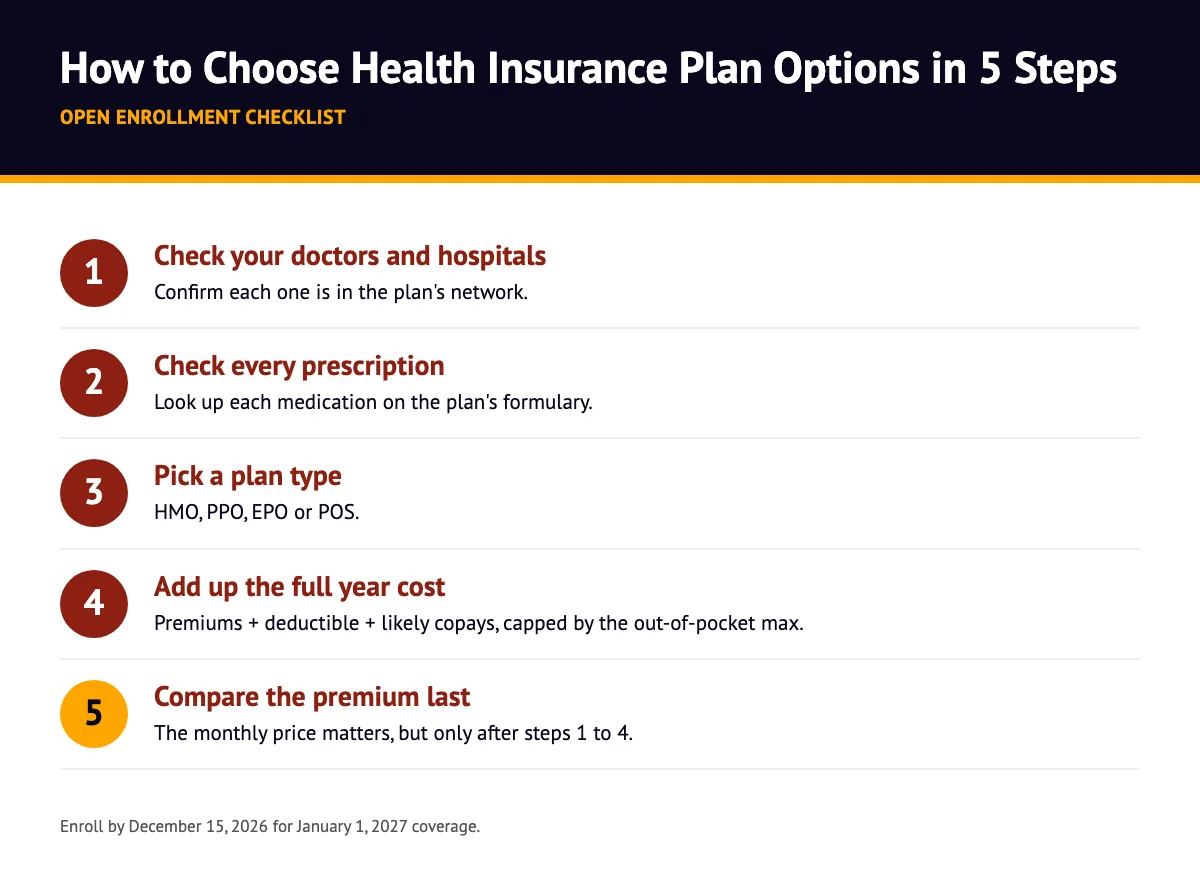
The short version, in five steps:
- Check that your doctors and hospitals are in the network.
- Check every prescription on the plan’s drug list.
- Pick the plan type that fits how you use care: HMO, PPO, EPO or POS.
- Add up the full year cost, not just the monthly price.
- Compare premiums last, between plans that passed steps 1 to 4.
Why Does Open Enrollment Matter When You Choose a Plan?
Because it is the one time each year when every plan is open to you. Outside the window, you need a qualifying life event such as a move, a new baby or losing other coverage.
It is also the only time you can leave a plan that got more expensive. A price increase on its own does not open a special enrollment period later in the year.
And timing changes value. Deductibles reset every January 1, so a plan chosen now gives you twelve full months to use it.
| Choose your plan by | Coverage starts |
| December 15, 2026 | January 1, 2027 |
| December 16, 2026 to January 15, 2027 | February 1, 2027 |
| After January 15, 2027 | Only with a qualifying life event |
For the full calendar, see when is open enrollment for health insurance 2027.
Step 1: Are Your Doctors in the Network?
Check this first, because it rules plans in or out before price even matters. A provider network is the list of doctors, hospitals and labs a plan has contracts with.
See a doctor outside it and you may pay the full bill, or a much larger share of it. On some plans, out-of-network care is not covered at all except in emergencies.
How to run the check properly:
- List every provider by name. Your primary care doctor, any specialists, your preferred hospital and urgent care.
- Search each one in the carrier’s provider directory. Use the directory for the exact plan, not the carrier in general. One carrier can run several networks.
- Call the doctor’s office to confirm. Directories are not always current. Ask, “Do you take this specific plan for 2027?”
Networks also differ by county. A plan with a broad network in Dallas can be narrow in Lubbock, so always search with your own zip code.

Step 2: Are Your Prescriptions Covered?
Every plan has a formulary, the list of drugs it covers. Drugs are sorted into tiers, and each tier has a different copay or coinsurance.
A plan can cover your medicine and still charge far more for it than another plan, because it sits on a higher tier. Look up each drug by name and dose.
Also note any drug marked for prior authorization or step therapy. Those mean the plan wants approval first, or wants you to try a cheaper drug before it pays for yours.
Step 3: HMO, PPO, EPO or POS: Which Plan Type Fits You?
The plan type decides how freely you can see doctors. This is where most of the trade-off between price and flexibility sits.
| Plan type | Need a referral for specialists? | Out-of-network care covered? | Tends to suit |
| HMO | Usually yes | No, except emergencies | People happy with one local network and a lower premium |
| PPO | No | Yes, at a higher cost | People who want to keep specific doctors or see specialists directly |
| EPO | Usually no | No, except emergencies | People who want PPO-style access inside one network |
| POS | Yes | Yes, at a higher cost | People who want a primary doctor to coordinate but some flexibility |
Should you get an HMO or a PPO? If your doctors are all in one HMO network and you rarely see specialists, an HMO usually costs less. If you travel, see several specialists, or have a doctor you will not give up, a PPO is often worth the higher premium.
In much of Texas, plans sold on HealthCare.gov lean toward HMO and EPO networks. Broader PPO networks are more often found in private plans bought directly from a carrier and in association health plans.
Our comparison of HSA vs PPO vs HMO plans goes deeper on each type.
Step 4: What Will the Plan Cost You for the Whole Year?
This step is where knowing how to choose health insurance plan options really pays off. The monthly premium is only one of five costs:
| Cost | What it means |
| Premium | What you pay every month to keep the plan, whether you use it or not |
| Deductible | What you pay for covered care before the plan starts sharing costs |
| Copay | A flat fee for a visit or a drug, such as $30 for a doctor visit |
| Coinsurance | Your percentage of a bill after the deductible, such as 20 percent |
| Out-of-pocket maximum | The most you pay for covered in-network care in a year, after which the plan pays 100 percent |
The out-of-pocket maximum is your worst case. For 2027, major medical plans can set it no higher than $12,000 for one person and $24,000 for a family, up from $10,600 and $21,200 in 2026. Many plans set it lower, so compare it plan by plan.
A simple way to estimate the full year cost:
- Light year: 12 months of premium, plus a few copays.
- Expected year: 12 months of premium, plus the care you already know you will need.
- Bad year: 12 months of premium, plus the out-of-pocket maximum.
Run all three for each plan. A plan that is $60 a month cheaper can still cost you thousands more in a bad year if its out-of-pocket maximum is higher.
Should You Choose a High Deductible Plan With an HSA?
It can be the cheapest choice if you are generally healthy and can set money aside. A high deductible health plan has a lower premium, and if it is HSA-qualified you can save into a health savings account tax free.
For 2027, the IRS limits are:
| Self-only | Family | |
| Minimum deductible to qualify | $1,750 | $3,500 |
| Maximum out-of-pocket | $8,700 | $17,400 |
| HSA contribution limit | $4,500 | $9,000 |
People 55 and older can add a $1,000 catch-up contribution. These figures come from the IRS 2027 limits.
Any plan type can be built as an HSA-qualified plan, including a PPO. To check whether a plan qualifies, read our guide to HSA eligible health plans, or the full high deductible health plan guide.
What About Metal Tiers on Marketplace Plans?
If you shop on HealthCare.gov, plans are grouped into Bronze, Silver, Gold and Platinum. The tier tells you roughly how the plan splits costs with you on average.
| Metal tier | Plan pays on average | You pay on average |
| Bronze | 60% | 40% |
| Silver | 70% | 30% |
| Gold | 80% | 20% |
| Platinum | 90% | 10% |
HealthCare.gov explains the categories in more detail. Metal tiers say nothing about the network, so steps 1 and 2 still come first.
Metal tiers are a Marketplace label. Private plans bought off the exchange and association plans are not sorted this way, so compare those on deductible, network and out-of-pocket maximum instead.
If you are weighing the exchange, our guide to ACA open enrollment in Texas covers who it suits.
Step 5: Now Compare the Premiums
By now you have a short list: plans with your doctors, your drugs, a plan type you are comfortable with and a full year cost you can live with. Compare premiums only between those.
This order is the core of how to choose health insurance plan coverage well. The premium decides between good options. It should never decide which options count as good.
Keep in mind that 2027 rates are rising for many people. Our guide to whether health insurance is cheaper during open enrollment explains what is driving the increases.
What Documents Should You Read Before You Enroll?
Every major medical plan must give you a Summary of Benefits and Coverage. It uses the same layout for every carrier, so it is the easiest way to compare plans side by side.
Look for three things in it:
- The deductible and out-of-pocket maximum, for one person and for the family.
- Coverage examples, which show what you would pay for a baby’s birth or managing diabetes.
- What is excluded, such as certain therapies or out-of-network care.
Also open your renewal letter if you already have a plan. It shows next year’s premium and any network changes on your current plan.
Should You Let Your Current Plan Renew?
Only if you checked it first. Auto-renewal keeps you covered, but at the new price and with the new network.
Plans change every year. A doctor can leave the network, a drug can move to a higher tier, and the deductible can rise. If your plan passes steps 1 to 4 again, renewing is fine.
If you choose and then change your mind, you can switch as often as you like before the deadline. After it closes, the rules tighten, as our guide on whether you can change your health insurance plan after enrolling explains.
How to Choose Health Insurance Plan Options for Your Situation
The five steps apply to everyone, but some situations change the answer.
- You are self-employed or between jobs. You are buying on your own, so a private PPO or association plan is worth pricing next to the exchange. See health insurance between jobs.
- You are offered COBRA. It keeps your exact plan and deductible progress, but it is often expensive. Compare it with the options in our COBRA open enrollment guide.
- You are turning 26. You can stay on a parent’s plan until then. Line up a replacement before the date, as our turning 26 guide explains.
- You have a family. Check the family deductible and whether it is embedded, meaning each person has their own smaller deductible inside the family one.
- You have an ongoing condition. The out-of-pocket maximum matters more than the premium, because you are likely to reach it.
Should You Use a Broker or Choose on Your Own?
You can do every step above yourself. It just takes time, usually an evening per plan once you include the network calls.
A licensed broker does not cost you anything extra. Brokers are paid by the carriers, and the premium is the same whether you buy through one or on your own.
What changes is the comparison. An agent who works for one carrier can only show that carrier’s plans. A broker appointed with several carriers can compare them side by side, including private PPO and association options you will not see on HealthCare.gov.
One honest limit: a broker can only place plans from carriers they are appointed with. Ask which carriers they work with before you start.
Frequently Asked Questions
What do I look for when choosing health insurance?
Your doctors and hospitals in the network, your prescriptions on the drug list, the plan type, and the full year cost including the out-of-pocket maximum. The premium comes last.
Which is better, a PPO or an HMO?
Neither is better for everyone. An HMO usually costs less but limits you to its network and needs referrals. A PPO costs more but lets you see specialists directly and covers some out-of-network care.
Is $500 a month normal for health insurance?
It can be. Premiums depend mainly on your age, your county, tobacco use and who is on the plan. For an older adult or a family it is common, while for a healthy 25-year-old it is on the high side. Judge the plan on full year cost, not the monthly figure.
What does open enrollment mean in health insurance?
It is the yearly window when anyone can buy or change a plan without a qualifying life event. For 2027 coverage in Texas it runs from November 1, 2026 to January 15, 2027. Our complete Texas open enrollment guide covers it in full.
Is it cheaper to not have health insurance?
Only until you need care. There is no federal or Texas penalty for going without coverage, but you pay full price for every bill, with no out-of-pocket maximum to cap it.
What happens if I miss the deadline?
You will usually have to wait until next November unless you have a qualifying life event. Some coverage is not tied to open enrollment, as our guide to getting health insurance outside of open enrollment explains.
Closing Thoughts
Knowing how to choose health insurance plan coverage comes down to order. Do the checks that can rule a plan out first, and let price decide last.
- Network first. Search every doctor by name, then call to confirm.
- Drugs second. Check the tier, not just whether a drug is listed.
- Plan type third. Match HMO, PPO, EPO or POS to how you use care.
- Full year cost fourth. Run a light, expected and bad year.
- Premium last. Choose by December 15 for January 1 coverage.
For more background, see our earlier guide on choosing the right health insurance plan in Texas. If you would like a side-by-side comparison of PPO, private and association plans, call (469) 361-4032 or ask for a free quote. There is no fee and no obligation.