
Open enrollment for 2027 health insurance runs November 1, 2026 through January 15, 2027. To have coverage that starts January 1, 2027, you must enroll by December 15, 2026. Enroll between December 16 and January 15 and your coverage starts February 1 instead. Texas uses the federal Marketplace, so these dates apply statewide.
When is open enrollment for health insurance 2027? The dates are settled now, but they were changed twice before they landed, and several guides still show the old ones.
This page gives you the confirmed calendar, what happens on each date, and the work worth doing now, before November 1.
Key takeaways:
- Open enrollment 2027: November 1, 2026 to January 15, 2027.
- December 15, 2026 is the cutoff for January 1 coverage.
- The January 15 end date was restored after a court ruling, having been cut to December 15.
- Marketplace rates rose a median 15% for 2027, so last year’s price is a poor guide.
If You’re in a Rush
- November 1, 2026: window opens.
- December 15, 2026: enroll by today for coverage on January 1.
- January 15, 2027: last day to enroll at all.
- Before November: find your renewal notice, list your doctors, list your prescriptions.
- Do not rely on last year’s premium. Rates moved significantly.
- Want your current plan checked against the 2027 market? Custom Health Plans reviews it at no cost. Call (469) 361-4032.
When Is Open Enrollment for Health Insurance 2027?
Open enrollment for 2027 individual coverage runs November 1, 2026 to January 15, 2027 on the federal Marketplace, which is what Texas uses.
Here is the full calendar, including the dates that decide when coverage actually starts.
| Date | What happens |
| November 1, 2026 | Open enrollment begins. Plans and 2027 prices go live. |
| December 15, 2026 | Last day to enroll for a January 1, 2027 start. |
| January 1, 2027 | Coverage begins for December 15 enrollees. |
| January 15, 2027 | Open enrollment ends. Last day to enroll. |
| February 1, 2027 | Coverage begins for those who enrolled Dec 16 to Jan 15. |
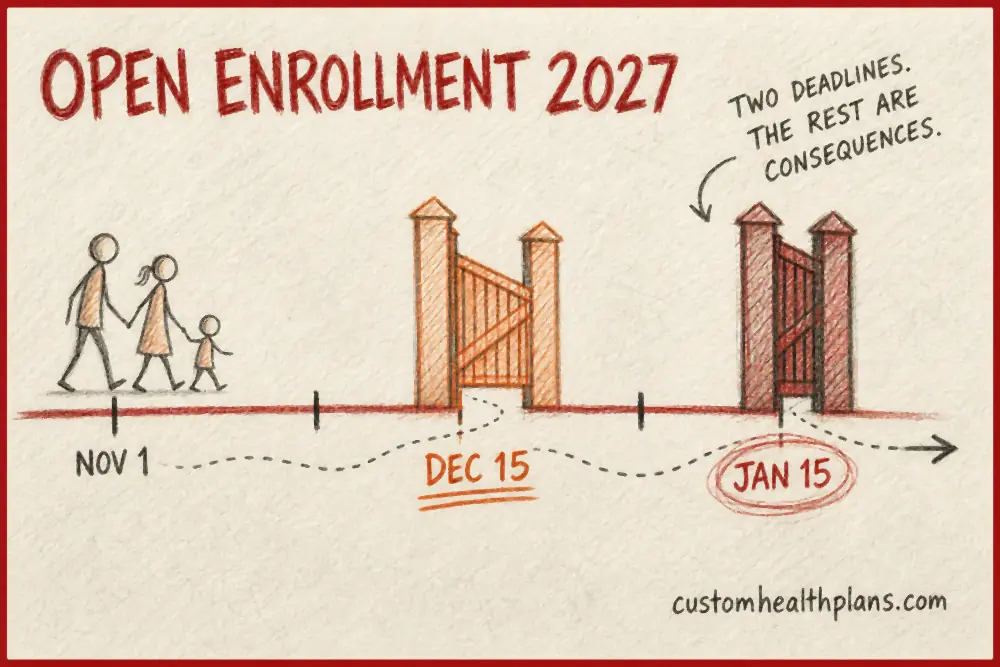
Two of these dates are deadlines. The rest are consequences.
December 15 decides whether you have a coverage gap in January. January 15 decides whether you have coverage at all.
These dates apply to individual and family plans you buy yourself. Employer plans and Medicare run separate windows.
Why Was the 2027 End Date Changed?
The 2027 end date moved from January 15 to December 15 and back again, which is why stale guides disagree with each other.
The timeline is short and worth knowing.
First, the 2025 Marketplace Integrity and Affordability final rule shortened the federal window to November 1 through December 15 starting with plan year 2027. The American Hospital Association reported the rule in June 2025.
Then a federal court vacated that December 15 provision in June 2026.
Then in July 2026, CMS announced the federally facilitated Marketplace would run November 1, 2026 through January 15, 2027, as reported by healthinsurance.org.
So you have a full extra month compared with what was planned a year ago.
Practical test for any page you read: if it does not carry a “last updated” date after July 2026, treat its end date as unverified.
What Should You Do Before November 1?
The most useful open enrollment work happens before the window opens. By November 1 you want your facts assembled, not your research starting.
Four things, and none of them take long.
- Find your renewal or plan change notice. Carriers mail these in the fall. It tells you what your plan is doing in 2027.
- List your doctors. Every provider you actually want to keep, by name and practice.
- List your prescriptions. Exact drug names and dosages. Formularies change yearly.
- Check your income estimate. If you take a premium tax credit, it is calculated from projected income. A stale number causes a reconciliation bill at tax time.
That is the whole preparation. It fits in one envelope and one note on your phone.
The broker angle: the date is public and free. The comparison is the work. Anyone can tell you November 1. Nobody hands you a side by side of what your doctors cost under each plan in your county.
Is Your 2027 Premium Going Up?
Probably, and by more than usual. Insurers proposed a median 15% increase for 2027 Marketplace plans, the second consecutive year of double digit rises.
The Peterson-KFF Health System Tracker reviewed filings from 276 insurers across all 50 states and D.C.
- Proposed changes span -1% to 54%, with about 63% landing between 10% and 25%.
- The 15% median for 2027 follows an 18% median for 2026.
- Median medical trend was 10%, up from the 8% typical in recent years.
- Roughly 4 percentage points of the increase is attributed to a sicker risk pool.
- One Texas insurer applied a 6.0% morbidity adjustment for expected market contraction.
Separately, enhanced premium tax credits expired at the end of 2025. KFF estimated that alone would raise average Marketplace premium payments 114%, from $888 to $1,904 a year.
Here is how the last two years compare.
| Measure | 2026 | 2027 |
| Median proposed rate increase | 18% | 15% |
| Median medical trend | about 8% | 10% |
| Enhanced premium tax credits | Expired end of 2025 | Not in effect |
| Range of proposed changes | Double digit median | -1% to 54% |
These are proposed rates. Final approved rates can come in lower, and your own change depends on your age, county and plan.
What Happens If You Enroll After December 15?
You are still enrolled, but your coverage starts February 1 instead of January 1. You carry a one month gap you paid nothing for and got nothing from.
That gap is the real cost of a late December enrollment, and it is easy to underestimate.
During a January gap you would be responsible for:
- Any emergency room visit or hospital stay in full.
- Prescription refills at cash price.
- Routine appointments at full rate.
- Any deductible progress, which restarts at zero when the plan begins anyway.
If you know you will miss December 15, it is worth pricing a short term plan for the single month. That is a gap filler, not a replacement.
Be clear on what it is not: short term plans are not ACA compliant major medical. They can exclude pre-existing conditions and may have no out of pocket cap. Our short term health insurance in Texas guide sets out the trade offs.
Do You Have to Do Anything If You Like Your Plan?
Usually no. Most Marketplace plans auto-renew you into the same plan, or the closest available one if yours was discontinued.
This is a genuine safety net, and for plenty of people it is the right outcome.
But three things can change underneath an auto-renewal:
- The premium, which resets every January.
- The subsidy, recalculated from the income on file.
- The plan, if yours was discontinued and you were mapped to a replacement with a different network.
So the minimum job is not “shop around”. It is “open the notice and confirm nothing important moved”.
The honest limitation: if your plan has not changed, your doctors are still in network and you are happy with the price, auto-renewal is fine. You do not need a broker, a navigator, or an afternoon of comparison. Doing nothing is a legitimate answer.
When Is Open Enrollment If You Have Employer Coverage?
Employer open enrollment is set by your employer, not by the federal Marketplace. Most run a two to four week window in the fall for a January 1 start.
Your HR team announces the dates. They will not match November 1 to January 15, and they do not have to.
A few differences worth holding in mind:
- Your employer’s window is usually shorter. Two weeks is common.
- Missing it is stricter. You typically wait a full year unless you have a qualifying life event.
- You can still compare. If your employer contribution is small, or family coverage is expensive, an individual plan is worth pricing against it.
If you are moving between jobs during this period, the timing gets more complex. We cover it in health insurance between jobs in Texas.
What If You Miss January 15 Entirely?
You wait for the next open enrollment unless you qualify for a special enrollment period. A qualifying life event opens a 60 day window, per HealthCare.gov.
Qualifying events include losing coverage, moving, marriage, a birth or adoption, divorce, turning 26, and losing Medicaid or CHIP.
If none applies, some plan types are not tied to open enrollment at all. Short term, fixed indemnity and association health plans can be bought in other months.
For the full picture, see missed open enrollment in Texas.
One honest note: if you are subsidy eligible and can safely wait until the next January, waiting is often cheaper than buying a stopgap. That is worth calculating before you buy anything.
What Documents Do You Need to Enroll?
You need less than people expect. For a straightforward Marketplace enrollment, identity and income details cover most of it.
Have these ready before November 1 and the application takes minutes rather than an evening.
- Social Security numbers for everyone applying.
- Date of birth and address for each person on the plan.
- An income estimate for 2027. Pay stubs, a recent tax return, or your own projection if you are self employed.
- Current policy details if you have coverage now, including the plan name and member ID.
- Employer coverage information if anyone in the household is offered a plan at work.
That last one catches people out. If you are offered affordable employer coverage, it can affect whether you qualify for a premium tax credit.
Self employed income is the hardest line to fill in honestly. Estimate on the realistic side rather than the hopeful side, because the credit is reconciled against actual income when you file.
Can You Change Your Plan After You Enroll?
Yes, as many times as you like, as long as open enrollment is still open. Only the last plan you select before the deadline takes effect.
This is one of the more useful and least known rules of the window.
It means you can enroll early to be safe, then keep looking. If you find something better on January 10, you can switch to it and the earlier choice simply falls away.
A few practical points:
- Switch before December 15 if you want the new plan to start January 1.
- Switching after December 15 but before January 15 moves your start to February 1.
- Once January 15 passes, changing plans requires a qualifying life event.
The honest limitation: enrolling early and switching later only works inside the window. After January 15 the flexibility disappears completely, and no broker or navigator can reopen it for you.
Is There Any Way to Get an Extension?
No. Open enrollment deadlines are federal and fixed. Nobody can extend them for you, and you should be wary of anyone who suggests otherwise.
There are two narrow exceptions, and neither is an extension in the way people mean it.
- A declared emergency. CMS has occasionally opened special windows after hurricanes or federally declared disasters affecting a region.
- An enrollment error. If a technical problem on HealthCare.gov stopped you completing an application before the deadline, you can request a review.
Neither is something to plan around. Both are exceptions granted after the fact, not options you can choose.
The honest limitation, stated plainly: a broker cannot extend a federal deadline. No licensed agent, navigator or carrier representative has that power. If January 15 passes without a qualifying life event, the major medical door is closed until the next November.
Closing thoughts
Open enrollment for 2027 health insurance runs November 1, 2026 through January 15, 2027, with December 15, 2026 as the deadline for January 1 coverage.
- Two dates decide everything: December 15 for a January start, January 15 to enroll at all.
- Verify the end date on anything you read. It was changed twice.
- Prepare before November 1: renewal notice, doctors, prescriptions, income estimate.
- Expect movement on price. The 2027 median proposed increase was 15%.
- Happy with your plan and nothing changed? Auto-renewal is a fine answer.
If you would like your current plan compared against what is available in your Texas county for 2027, Custom Health Plans can do that at no cost. Call (469) 361-4032 or request a quote.