
Quick answer: When is ACA open enrollment? It runs November 1 to January 15 in Texas, which uses the federal Marketplace at HealthCare.gov. Enroll by December 15 for coverage that starts January 1. That is the whole calendar.
The dates are the easy part, and almost nobody gets stuck on them.
What people get stuck on is what they are choosing between: ACA or private, on the exchange or off it, Bronze or Silver, and whether the help on offer is worth taking. That is what the rest of this page covers.
What Does ACA Actually Mean?
The ACA is a law, not an insurance company. The Affordable Care Act sets the rules that health plans have to follow, and “Obamacare” is the same thing under a nickname.
This trips people up constantly, so it is worth being plain about.
Blue Cross Blue Shield, Aetna, Cigna and UnitedHealthcare are insurance companies. Several of them sell ACA plans. The ACA is the rulebook they are selling under, not a competitor to them.
When a plan is described as ACA compliant, it means the plan does all of the following:
- Covers pre-existing conditions, with no exclusions and no higher price for your health history.
- Includes the essential health benefits, a defined list that covers hospital care, prescriptions, maternity, mental health and more.
- Caps your out of pocket spending for the year, so there is a ceiling on a bad year.
- Cannot be cancelled because you got sick or hit a claims limit.
Those four protections are the product. Everything else, including the carrier’s name on the card, sits on top of them.
Plans that are not ACA compliant still exist and are sold legally. They can ask about your health history and leave things out, which is a real difference rather than a technicality.
When Is ACA Open Enrollment for Texas Residents?
Texas does not run its own exchange, so Texans use HealthCare.gov and the federal dates apply here without exception.
| The date | What it does |
|---|---|
| November 1 | Enrollment opens and the coming year’s plans and prices appear |
| December 15 | Enroll by this date for coverage starting January 1 |
| January 15 | Enrollment closes |
A handful of states run their own exchanges and set their own schedules, so a deadline you read about for California or New York may not be yours.
The end date is also worth checking on anything you read. It was moved and then moved back within about a year, per healthinsurance.org, so older pages still print the wrong one. If you want the sequence, the 2027 dates lay it out, and why the window exists at all explains why it cannot be moved for you.
Who Can Enroll in an ACA Plan?
Most people can. The eligibility rules are broader than people expect, and there is no health test of any kind.
To buy a Marketplace plan you generally need to live in the service area, be a US citizen or lawfully present, and not be incarcerated.
Two situations change the answer:
- You have Medicare. You cannot buy a Marketplace plan to replace it, and it is illegal for someone to sell you one for that purpose.
- You are offered affordable coverage at work. You can still buy a Marketplace plan, but you will usually lose the subsidy, which changes the maths considerably.
Income does not decide whether you can enroll. It decides whether you get help paying, which is a separate question and the one people really mean when they ask about qualifying.
If your income is low enough, Medicaid or CHIP may be the better route, and neither has an enrollment window at all. In Texas the Medicaid thresholds for adults are unusually tight, so plenty of people who would qualify in other states do not qualify here.
How Do ACA Subsidies Actually Work?
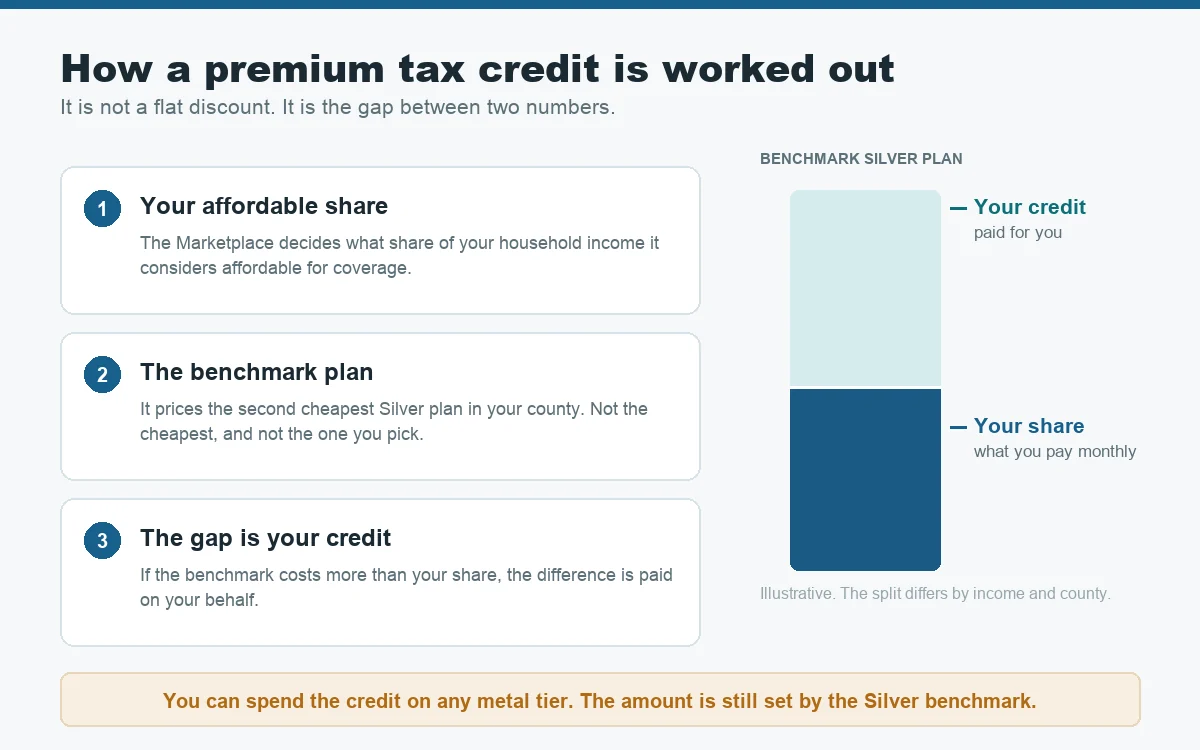
A premium tax credit lowers what you pay each month, and it is calculated from your household income compared with the cost of a benchmark plan in your county.
The mechanism is worth understanding, because it explains several things that otherwise look strange.
The Marketplace works out what it considers an affordable share of your income for health coverage. It then compares that with the price of the second-cheapest Silver plan where you live. If the plan costs more than your affordable share, the difference becomes your credit.
Three consequences follow from that, and they surprise people:
- The credit is tied to a Silver plan even if you buy Bronze or Gold. You can apply it to any metal tier, but the amount is set by the Silver benchmark.
- Where you live changes your credit, because local plan prices do. Two households on identical incomes in different counties get different amounts.
- It is an estimate all year, settled at tax time. You are paid in advance based on projected income, then reconciled when you file. Underestimate your income and you repay some of it.
That last point is the one that causes genuine pain, particularly for self employed and commission-based households. An optimistic income estimate feels good in January and arrives as a bill in April.
Income limits for the credit have changed more than once in recent years and are the sort of detail that goes stale quickly. Check your own eligibility on HealthCare.gov or with someone licensed rather than trusting a figure on a blog, including this one.
Is ACA Coverage Cheaper Than Private Insurance?
It depends almost entirely on whether you qualify for a subsidy, and the comparison people think they are making is usually not the real one.
Here is the part that clears up most of the confusion. Off-exchange plans sold directly by carriers are usually ACA compliant too. Both are the same regulated product. The difference is the shelf you buy from, not the rulebook.
| On the exchange | Off the exchange | |
|---|---|---|
| Where you buy | HealthCare.gov | Carrier or broker |
| Premium tax credit | Yes, if eligible | No |
| Pre-existing conditions covered | Yes | Yes, on ACA compliant plans |
| Essential health benefits | Yes | Yes, on ACA compliant plans |
| Plan types common in Texas | Mostly HMO | More PPO availability |
So the sequence is simple. Check subsidy eligibility first. If you qualify, the exchange is almost always where you belong, because the credit exists nowhere else. Buying the identical plan off-exchange means paying full price by choice.
If you do not qualify, the off-exchange shelf genuinely becomes worth a look, mainly because that is where more of the PPO options sit in Texas.
One thing did change recently and is worth knowing. Enhanced premium tax credits expired at the end of 2025, so households that used to receive a substantial credit may now receive a smaller one or none. That does not make the exchange the wrong answer. It means the comparison you ran a couple of years ago is out of date and deserves rerunning.
What Are the Metal Tiers, and Why Is Silver Different?
ACA plans are sorted into Bronze, Silver, Gold and Platinum. The tier describes how you and the plan split costs. It says nothing about the quality of your care or your doctors.
A higher tier means a higher premium and lower costs when you use care. A lower tier means the opposite.
| Tier | Premium | Your costs when you use care | Tends to suit |
|---|---|---|---|
| Bronze | Lowest | Highest | Healthy, wanting protection from disaster |
| Silver | Moderate | Moderate | Most people, especially if subsidy eligible |
| Gold | Higher | Lower | Regular care or ongoing prescriptions |
| Platinum | Highest | Lowest | Heavy, predictable medical use |
Silver has a feature the others do not. Cost sharing reductions lower your deductible and your copays, they are only available on Silver plans, and only if your income falls in the qualifying range.
The effect is that a Silver plan can quietly be better value than Gold for an eligible household, even though Gold looks like more coverage on paper. If you are subsidy eligible, price Silver first and then compare.
If you are not eligible, the tier choice comes down to a straightforward question: how much care do you realistically expect to use next year?
What Is the Downside of Marketplace Coverage?
The most common complaint in Texas is network width, not the coverage itself.
Exchange offerings here lean heavily toward HMO plans. An HMO usually costs less, asks you to stay in network, and requires referrals to see specialists.
That works well if your doctors are in the network and you mostly get care near home. It works badly if either of those is untrue.
The friction usually shows up as:
- A specialist who is out of network, where the plan pays nothing outside an emergency.
- Coverage that does not travel if you split time between cities or have a child at college elsewhere.
- Referrals adding delay when you already know who you need to see.
- Networks changing annually, so last year’s in-network doctor may not be this year’s.
None of that makes Marketplace coverage a bad product. It is comprehensive, it covers pre-existing conditions, and with a subsidy it is frequently the best value available to a Texas household.
It does mean the network check is the step that decides whether a plan fits you. If a wider network matters more than the premium, comparing Texas individual plans is where the PPO options show up.
Should You Just Let Your Plan Auto-Renew?
Sometimes yes. Auto-renewal is a real safety net and for plenty of households it is the right outcome.
It keeps you covered on January 1 without you doing anything, which beats an accidental gap by a distance.
The case for looking anyway is that three things can move while you sit still. Your premium resets each year. Your subsidy is recalculated from whatever income figure is on file, which may be old. And if your plan is discontinued, the carrier maps you to the nearest replacement it sells, chosen for being closest, not for matching your doctors.
Your carrier sets all of this out in the notice it mails in the fall. It is the one piece of post worth opening properly, and the 2026 and 2027 guide goes through what it contains.
A reasonable rule: if nothing about your health, your doctors, your prescriptions or your income has changed, and the notice says your plan is continuing on similar terms, renewing is a perfectly good decision. If any of those moved, it is worth an hour.
How Do You Enroll, and Who Can Help?
Three routes, all free to you, and the honest answer is that plenty of people are well served by the first one.
| On your own | Navigator | Licensed broker | |
|---|---|---|---|
| Cost to you | Free | Free | Free, paid by the carrier |
| Shows on-exchange plans | Yes | Yes | Yes |
| Shows off-exchange plans | No | No | Yes |
| Can recommend a specific plan | n/a | No | Yes |
| Helps with subsidy applications | Self-serve | Yes | Yes |
| Helps after you enroll | No | Limited | Usually |
| Available year round | Yes | Mostly seasonal | Yes |
Doing it yourself works well when your plan has not changed, your income is simple to estimate, and you have no specialists or ongoing prescriptions to protect. HealthCare.gov is free, and the application is not the hard part.
Navigators are trained and federally funded, and they are impartial by design. The trade-off is that a navigator cannot recommend a specific plan to you. If you want the rules explained without a recommendation, they are genuinely the right choice.
Brokers are state licensed and paid by the carrier rather than by you, so the plan costs the same whether you use one or not. They can show both the on-exchange and off-exchange shelves and will tell you which they would pick.
The honest limitation on brokers, including us: no agent in Texas is appointed with every carrier, so any broker is showing you a subset of the market. Ask which carriers they hold before you start, so you know the edges of what you are being shown.
A second opinion tends to earn its keep when there are doctors you are unwilling to lose, when your plan is being discontinued, when your income is variable, or when you are weighing on-exchange against off-exchange. It earns much less when the decision is straightforward.
Can You Enrol in an ACA Plan at Any Time?
No, and that is the one rule with no flexibility in it. Outside the annual window you need a qualifying life event.
Losing coverage, moving, marriage, divorce, a new baby or turning 26 each open a special enrollment period of 60 days, according to HealthCare.gov. Our guide to open enrollment versus special enrollment sets the two side by side.
Medicaid and CHIP are the exception that genuinely has no window. If your income qualifies, you can apply in any month.
If neither applies, what is left is coverage that sits outside the ACA rules, such as short term health insurance, fixed indemnity plans or an association health plan.
Be clear about the trade. Short term and fixed indemnity plans are not ACA compliant. They can ask about your health history, exclude pre-existing conditions and carry no cap on what you pay out of pocket. They bridge a gap. They do not replace comprehensive coverage, and anyone who tells you otherwise is selling rather than advising.
Missed open enrollment in Texas covers what remains when none of the routes above apply.
How Do You Check If Your Doctor Is In Network?
Check the carrier’s own provider directory using the exact plan name, then confirm by phone with the practice. Both steps matter.
Comparison tools and aggregator sites lag behind, and a directory can be right about the carrier while being wrong about the specific plan. Networks are plan-level, not carrier-level, which is the detail that catches people.
When you call the practice, ask whether they are in network for that exact plan name for the coming year, not whether they “take” the carrier. Those are different questions and the second one gets you a misleading yes.
Do the same for prescriptions. Find each drug on the plan’s formulary and note the tier, because a covered drug on an expensive tier is a different proposition from a covered drug on a cheap one.
For a broader view of how Texas coverage fits together, our Texas health insurance marketplace page and the complete guide to open enrollment both go wider than this page does.
Conclusion
ACA open enrollment in Texas runs from November 1 to January 15, and the dates are the least interesting part of the decision.
- The ACA is a rulebook, not a carrier. Familiar insurance companies sell plans under it.
- Subsidies only exist on the exchange, so check eligibility before you compare anything else.
- Silver behaves differently because of cost sharing reductions, and it is worth pricing first if you qualify.
- The network check decides the fit, and it has to be done per plan, not per carrier.
- Auto-renewal is often fine. It is worth a second look when something in your life or your plan has moved.
If you would like someone to run the on-exchange and off-exchange options side by side for your county and your doctors, Custom Health Plans is a Texas brokerage and the comparison costs nothing. Call (469) 361-4032 or request a quote.