
Health insurance deductible explained: it is the amount you pay for covered care each year before your plan starts to pay its share. With a $2,500 deductible, you pay the first $2,500 of covered bills at your plan’s negotiated prices. After that, you usually pay a smaller share, such as 20%, and the plan pays the rest.
A deductible is one of the four numbers that decide what you really pay. It is also the one people misread most, because it is not your worst-case cost and it is not due up front.
This guide shows how a deductible works bill by bill, what counts toward it, and what a $1,000, $2,500, or $5,000 deductible means.
Four things to know about any deductible:
- It is a yearly amount. You work toward it with covered care, and most plans start it over each plan year.
- You pay it bill by bill. Nothing is due on the day your plan starts.
- Some care skips it. Preventive care and many copay visits are covered before you meet it.
- It is not your ceiling. The out-of-pocket maximum is the most you can owe.
Health Insurance Deductible Explained: How Does It Work Step by Step?
A deductible works like a yearly starting line. You pay for covered care until you reach it, and then your plan starts sharing the bill.
HealthCare.gov defines a deductible as the amount you pay for covered services before your plan starts to pay. With a $2,000 deductible, for example, you pay the first $2,000 of covered services yourself.
Here is the process in order:
- You pay your premium. This monthly bill keeps your plan active. It never counts toward your deductible.
- You get covered care. Your insurer lowers the provider’s bill to its negotiated price, called the allowed amount.
- You pay that allowed amount. It counts toward your deductible until you have paid the full deductible for the year.
- You meet your deductible. From here on, the plan shares each bill with you.
- You pay coinsurance or copays. Coinsurance is a percentage, such as 20%. A copay is a flat fee, such as $30 for a visit.
- You reach your out-of-pocket maximum. After that, the plan pays covered in-network care in full for the rest of the year.
You do not pay the deductible up front. You pay it as bills arrive, and the plan’s share starts only after the total reaches your deductible.
The deductible is one piece of a bigger system. Premiums, networks, and plan types all shape your total cost, and we cover them in how health insurance works.
Most plans start your deductible over when a new plan year begins.
What Counts Toward Your Deductible?
Money you pay for covered, in-network care at the allowed amount counts. That includes office visits, lab work, imaging, and hospital bills that your plan treats as subject to the deductible.
Several costs do not count. This table shows where each payment lands.
| What you pay | Counts toward your deductible? | Counts toward your out-of-pocket maximum? |
| Monthly premium | No | No |
| Covered in-network care, before you meet the deductible | Yes | Yes |
| Coinsurance, after you meet the deductible | Not applicable | Yes |
| Copay | Depends on your plan | Yes on ACA-compliant plans |
| Out-of-network care | Usually no, and varies by plan | No |
| Services your plan does not cover | No | No |
| Charges above the allowed amount | No | No |
The out-of-pocket column follows the federal rules for the limit. The limit includes deductibles, copayments, and coinsurance for in-network care. It excludes premiums, services your plan does not cover, out-of-network care, and costs above the allowed amount.
Your plan’s Summary of Benefits and Coverage shows the exact rules. A sample summary from CMS shows the layout, including the “Are there services covered before you meet your deductible?” row.
Do Copays Count Toward Your Deductible?
On many plans, no. A copay is a flat fee for a specific service, and it often sits outside the deductible, though it usually counts toward your out-of-pocket maximum.
This depends on the plan, so ask two separate questions about any copay:
- Does the copay apply before I meet the deductible?
- Does the copay count toward the deductible?
Those can have different answers. Your plan summary lists them side by side.
Do Prescriptions Count Toward the Deductible?
It depends on the plan. Some plans charge a small copay for common drugs even before you meet the deductible. Others make you pay the full negotiated drug price until the deductible is met.
Some plans have separate deductibles for certain services, like prescription drugs. Check your drug tier and whether a drug deductible applies.
Watch one more detail. Some plans use copay accumulator programs. KFF explains that with these programs, the value of a manufacturer coupon is applied to each fill but does not count toward your deductible or out-of-pocket maximum.
If you use a coupon for a costly drug, ask whether your plan has one.
What Does Insurance Cover Before You Meet the Deductible?
Preventive care comes first. Federal rules require all Marketplace plans and many other plans to cover listed preventive services without a copay or coinsurance, even if you have not met your deductible.
These services are generally covered at no cost when an in-network provider delivers them. The list includes blood pressure screening, cholesterol screening, colorectal cancer screening for adults 45 to 75, and depression screening.
Coverage can vary, and $0 is not guaranteed in every case. A routine checkup can turn into treatment for a new problem, and that part may be billed differently.
Many plans also cover some other care before the deductible:
- Primary care or urgent care visits for a copay
- Generic prescriptions for a copay
Do You Pay Full Price Until You Meet Your Deductible?
You pay the full allowed amount, not the full sticker price. The allowed amount is the discounted rate your insurer negotiated with in-network providers.
The federal coinsurance example shows it. If your allowed amount is $100 and you have not met your deductible, you pay the full allowed amount, $100.
Say a clinic bills $400 for a visit, but your plan’s negotiated rate is $250. You pay $250 if you have not met your deductible. That $250 then counts toward your deductible.
Going out of network changes this. A provider who charges more than the allowed amount may bill you for the difference. A preferred provider may not do that for covered services.
What Does a $1,000, $2,500, $4,000, or $5,000 Deductible Mean in Real Dollars?
It decides how much of your first bills you pay yourself. The bigger the deductible, the longer you pay full allowed amounts before the plan helps.
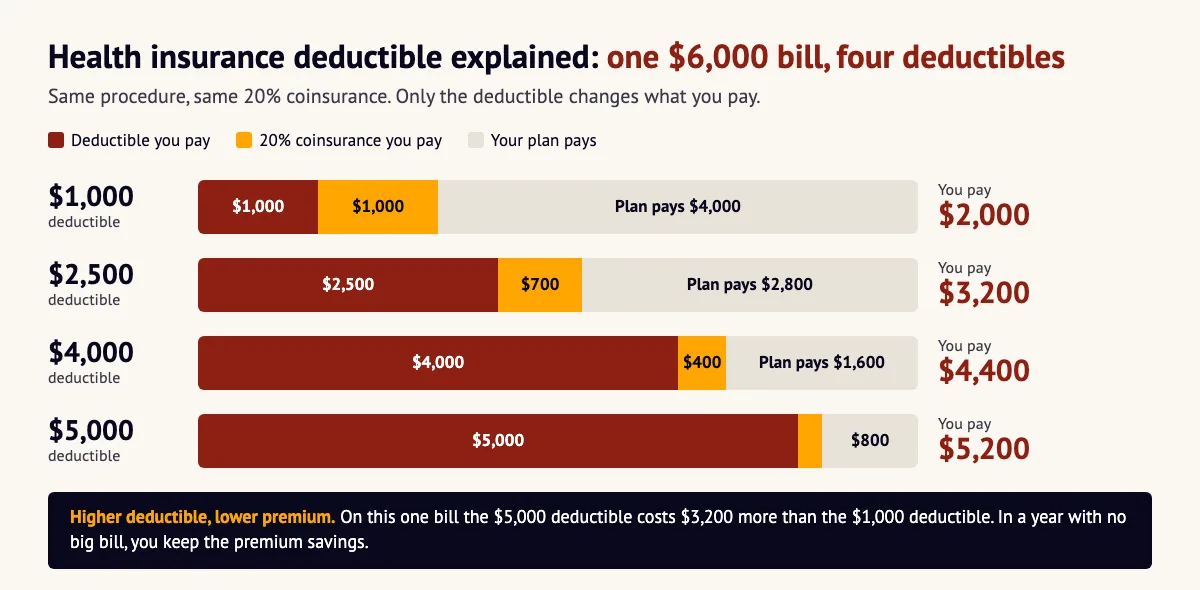
Take one $6,000 procedure at the negotiated price. Your plan has 20% coinsurance, and you have used none of your deductible. We assume your out-of-pocket maximum is higher than every total below.
| Your deductible | You pay toward the deductible | 20% coinsurance on the rest | You pay in total | Plan pays |
| $1,000 | $1,000 | $1,000 (20% of $5,000) | $2,000 | $4,000 |
| $2,500 | $2,500 | $700 (20% of $3,500) | $3,200 | $2,800 |
| $4,000 | $4,000 | $400 (20% of $2,000) | $4,400 | $1,600 |
| $5,000 | $5,000 | $200 (20% of $1,000) | $5,200 | $800 |
On this one bill, the $5,000 deductible costs you $3,200 more than the $1,000 deductible. In a year with no big bill, you would not feel that gap, and the lower premium would work in your favor.
That is why a deductible is a trade-off, not a good or bad number on its own.
### How Does a $2,500 Deductible Play Out Over a Full Year?
Here is a bill-by-bill tracker for a $2,500 deductible with 20% coinsurance. The plan charges a flat $40 copay for sick visits, and that copay does not reduce the deductible.
| When | What happens | Allowed amount | You pay | Deductible left |
| January | Annual checkup (preventive, in network) | $180 | $0 | $2,500 |
| February | Sick visit | $150 | $40 copay | $2,500 |
| April | Lab work and X-ray | $600 | $600 | $1,900 |
| June | MRI | $1,400 | $1,400 | $500 |
| September | Physical therapy | $900 | $500 deductible + $80 coinsurance = $580 | $0 |
| November | Urgent care | $300 | $60 (20%) | $0 |
Your total for care that year is $0 + $40 + $600 + $1,400 + $580 + $60 = $2,680. You met the deductible in September, and your plan began sharing costs from there.
Premiums are extra. At $450 a month, that would add $5,400 on top of the $2,680.

Is a Higher or Lower Deductible Better?
Neither is better for everyone. A lower deductible usually comes with a higher monthly premium, and a higher deductible usually comes with a lower premium.
Three questions help you decide:
- How much care do you expect? A planned surgery, a pregnancy, or ongoing treatment favors a lower deductible.
- How much cash could you pay on short notice? A deductible you cannot cover is a risk, even when the premium is low.
- Do you want an HSA? HSA-qualified plans have higher deductibles by design.
For context, the KFF 2025 Employer Health Benefits Survey puts the average single-coverage deductible at $1,886 for workers who have one. It also found that 34% of covered workers have a general annual deductible of $2,000 or more.
Size matters too. The same survey reports an average deductible of $2,631 at firms with 10 to 199 workers, against $1,670 at larger firms. Small business owners and their teams often carry more of this risk.
### Is a $2,500 Deductible a Good Health Insurance Option?
It can be. A $2,500 deductible is above the $1,886 average, but it is common. It fits you if you could pay it in a bad year and you want a lower premium than a $1,000 plan carries.
### Is a $5,000 Deductible High for Health Insurance?
Yes, compared with the averages above. It can suit a healthy person with savings set aside. It also means you pay most early bills yourself if you get hurt or sick.
### What Is a $0 Deductible in Health Insurance?
It means your plan starts sharing costs from the first covered bill. You still pay copays or coinsurance, and premiums are usually higher than on plans with a deductible.
What Is the Difference Between a Deductible and an Out-of-Pocket Maximum?
A deductible is what you pay before the plan starts sharing costs. The out-of-pocket maximum is the most you can pay in one plan year for covered, in-network care.
Your deductible counts toward the maximum, along with coinsurance and copays. Premiums do not.
For ACA-compliant plans, HealthCare.gov lists the limit at no more than $10,600 for an individual or $21,200 for a family in 2026. For 2027, it rises to no more than $12,000 or $24,000. Many plans set theirs lower.
Here is how the two work together. Your plan has a $2,500 deductible, 20% coinsurance, and a $7,500 out-of-pocket maximum. You have a hospital stay with a negotiated price of $30,000.
- You pay the $2,500 deductible.
- On the remaining $27,500, 20% would be $5,500.
- $2,500 + $5,500 = $8,000, which is over your maximum.
- Your cost stops at $7,500. The plan pays the other $22,500.
Learn what an out-of-pocket maximum is and how to read yours.
How Do Family Plans Handle the Deductible?
Family plans often have two deductibles. The individual deductible applies to each person, and the family deductible applies to all members together.
The CMS sample plan summary puts it this way: each family member must meet their own individual deductible until the total paid by all members meets the overall family deductible.
The details change what you pay in a year with one sick child or one big surgery. See how family and individual deductibles differ.
How Do High-Deductible Plans and HSAs Fit In?
A high-deductible health plan, or HDHP, has a higher deductible and usually a lower premium. If it is HSA-qualified, you can pair it with a health savings account and pay deductibles, copays, and coinsurance with pre-tax money.
The IRS sets the numbers each year in Rev. Proc. 2025-19. For 2026, an HDHP needs a deductible of at least $1,700 for one person or $3,400 for a family. Out-of-pocket costs are capped at $8,500 or $17,000.
The 2026 HSA contribution limit is $4,400 for one person and $8,750 for a family. For 2027, IRS Rev. Proc. 2026-24 sets a minimum deductible of $1,750 or $3,500 and a contribution limit of $4,500 or $9,000.
HSA-qualified plans generally cannot cover most non-preventive services until you meet the deductible. You pay the full cost of visits and prescriptions first. Preventive care is still covered at no cost.
Our guide to the high-deductible health plan covers who these plans fit best. Here is how an HSA works in plain English.
How Do PPO and Private Plans Change Your Deductible?
The plan type changes how the deductible works day to day. A PPO lets you see many providers without referrals. Care outside the network is covered at a higher cost to you, and many plans set a separate out-of-network deductible.
For a side-by-side look at plan types, see HSA vs PPO vs HMO.
Private individual and family plans bought directly from carriers offer a wide range of deductible levels.
Metal tiers like bronze and silver apply to Marketplace and group plans. They do not apply to off-exchange individual or association plans, so compare the real dollar amounts, not tier names.
Enrollment timing differs by product, too. Our guide on buying a PPO plan any time of year explains when each type can start.
Short-term and fixed indemnity plans are not major medical coverage. Fixed-indemnity plans pay a set amount, such as $100 per day in the hospital. Their deductibles and limits work differently, so read the terms closely.
Be honest with yourself about how often you use care. If you rarely see a doctor, a higher deductible and lower premium can win. If you have regular prescriptions or ongoing treatment, a lower deductible often costs less over the year.
Check your doctors, too. A strong deductible means little if your doctor is out of network.
How Custom Health Plans Helps
Custom Health Plans is a Texas health insurance broker. We compare plans from top carriers side by side, so you can see the deductible, premium, copays, out-of-pocket maximum, and network in one place.
Our quotes are free, and there is no broker fee to you. We have more than 30 years in health insurance and financial services, and we have helped hundreds of Texas families find coverage.
We have earned more than 400 five-star Google reviews. If your current plan is the better deal, we will say so.
Get a Free Quote or call (469) 361-4032.
Closing thoughts
Health insurance deductible explained in one line: it is what you pay for covered care each year before your plan starts sharing the bill, and you pay it as bills arrive.
- The deductible is not your ceiling. The out-of-pocket maximum is the most you can owe.
- You pay the negotiated price. The allowed amount counts, not the sticker price.
- Some care skips it. Preventive services and many copay visits are covered first.
- Premiums never count. They sit outside both your deductible and your maximum.
- Compare total yearly cost. Add twelve premiums to your likely care costs, then check your doctors.
For plans that fit your budget, see our Texas health insurance plans, or call (469) 361-4032 for a free side-by-side comparison.