
How does health insurance work? You pay a monthly premium to keep your plan active, and when you get care you share the bill through a deductible, copays, and coinsurance. After you reach your out-of-pocket maximum, the plan pays covered in-network care in full.
Health insurance looks complicated because every part has its own name. Premium, deductible, coinsurance, and network all sound alike until you see them on a real bill.
This guide explains each piece and follows one person through a full year of costs. It also answers the money questions people ask most, from “Is $500 a month normal?” to “What if I can’t afford care?”
Four things to check on any plan:
- The premium. The monthly price of keeping the plan active, whether or not you see a doctor.
- The deductible and cost sharing. What you pay before and after the plan starts sharing your bills.
- The out-of-pocket maximum. The most you can owe for covered in-network care in one plan year.
- The network. The doctors, hospitals, and pharmacies you can use at the lower price.
How Does Health Insurance Work, Step by Step?
Health insurance is a shared-cost agreement. You pay a regular fee, and the insurer pays a large part of your medical bills when you need care.
Here is the basic flow:
- You enroll and pay the premium. This keeps your coverage active, whether or not you see a doctor.
- You get care. Staying in your plan’s network keeps costs lower.
- The provider sends a claim. A claim is a request for payment that the doctor or hospital files with your insurer.
- The insurer and the provider agree on a price. This is called the allowed amount.
- You pay your share. That is your deductible, copay, or coinsurance, depending on the service.
- The plan pays the rest. Once you hit your out-of-pocket maximum, it pays covered in-network care at 100%.
A plan year is usually 12 months. Most of your cost sharing starts over when the new year begins. Read more on when your deductible resets.
What Is an Explanation of Benefits (EOB)?
After your insurer processes a claim, it sends you an Explanation of Benefits. CMS says an EOB is not a bill. It shows what the provider charged, what the plan allowed, what the plan paid, and what you owe.
The actual bill comes from the provider. Match the two before you pay.
What Is the Difference Between the Billed Amount and the Allowed Amount?
The billed amount is the provider’s list price. The allowed amount is the most your plan will count for that service.
HealthCare.gov explains that an out-of-network provider can bill you for the gap, while an in-network provider generally cannot on covered services. Say a clinic bills $300 and the in-network allowed amount is $180. You share the $180, and the other $120 is written off.
What Are Premiums, Deductibles, Copays, and Coinsurance?
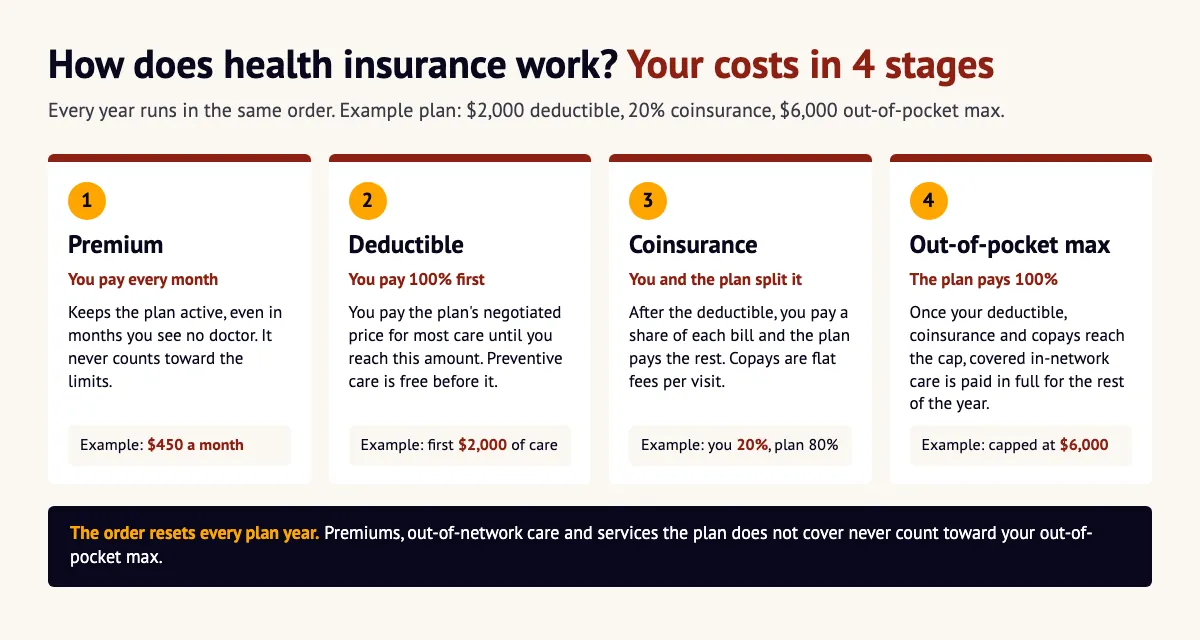
These four terms cover almost everything on a plan summary. Here they are side by side.
| Term | What it means | Simple example |
| Premium | The monthly price of the plan | $450 a month, paid even if you never see a doctor |
| Deductible | What you pay for covered care before the plan starts sharing costs | $2,000 a year |
| Copay | A flat fee for a specific service | $40 for a primary care visit |
| Coinsurance | Your percentage of the bill after the deductible is met | You pay 20%, the plan pays 80% |
Premiums are the price of staying covered. They do not count toward your deductible or your out-of-pocket maximum.
The deductible is what you pay first for most covered services. On a $12,000 surgery with a $2,000 deductible, you pay the first $2,000 before coinsurance begins. Our guide to how a deductible works goes deeper.
Deductibles vary a lot. In the KFF 2025 Employer Health Benefits Survey, covered workers with a deductible average $1,886 for single coverage, and 34% have a deductible of $2,000 or more.
Not sure what number is right for you? See what counts as a good deductible.
Copays are flat fees. You usually pay them at the visit or the pharmacy counter.
Coinsurance is a percentage. On a $100 allowed amount at 20% coinsurance, you pay $20.
Family plans add one more wrinkle. Both the family and each person have limits, and how family and individual deductibles differ can change what you pay.
Does the Deductible Apply to Every Visit?
No. Some services use a flat copay and skip the deductible, such as many office visits and generic prescriptions. Your plan documents show which ones.
Some care also skips it entirely. Under ACA-compliant plans, in-network preventive care, like annual checkups and many screenings, is covered at no cost to you, even before the deductible is met.
Surgery and hospital stays usually apply the deductible first.
What Is an Out-of-Pocket Maximum?
The out-of-pocket maximum is the most you will pay for covered, in-network care in one plan year. After you reach it, the plan pays 100% of covered in-network costs.
Deductibles, copays, and coinsurance count toward it. For 2026, the federal limit for ACA-compliant plans is $10,600 for one person and $21,200 for a family, rising to $12,000 and $24,000 in 2027.
Plans can set their limit lower, and many do. On a family plan, no single person pays more than the individual limit.
Short-term, fixed indemnity, and health sharing options are not built around this cap. Learn what an out-of-pocket maximum is and how to read yours.
What Happens When I Reach My Out-of-Pocket Maximum?
The plan pays 100% of covered in-network care for the rest of the plan year. You stop paying deductibles, copays, and coinsurance on those services.
Per HealthCare.gov, these still cost you and do not count toward the maximum:
- Monthly premiums
- Spending on services your plan does not cover
- Out-of-network care
- Charges above the allowed amount
When the next plan year begins, your deductible and out-of-pocket total start again.
What Is a Health Insurance Network?
A network is the group of doctors, hospitals, labs, and pharmacies that have agreed to accept your insurer’s negotiated prices.
Going in-network costs less. The insurer negotiates a discounted rate with each provider, and you pay your deductible, copay, or coinsurance on that discounted allowed amount.
Going out-of-network can cost much more, or may not be covered at all. An out-of-network provider may also bill you for the difference between their charge and the allowed amount, which is called balance billing.
Two other network terms show up often. A prior authorization means the plan must approve a service before you get it. A formulary is the plan’s list of covered drugs.
Before you enroll, check that your doctors and prescriptions are covered. A low price on a plan that excludes your doctor is not a bargain.
What Is the Difference Between HMO, PPO, EPO, and POS Plans?
These four letters describe how a plan’s network works. The main differences are whether you can leave the network and whether you need a referral.
| Plan type | Out-of-network care | Referral to see a specialist |
| HMO | Generally not covered, except in an emergency | Often required |
| PPO | Covered, at a higher cost to you | Not required |
| EPO | Generally not covered, except in an emergency | Usually not required |
| POS | Covered, at a higher cost to you | Required from your primary care doctor |
Details vary by insurer and plan, so check your plan documents. The table follows the plan type descriptions on HealthCare.gov.
In plain terms, an HMO has lower cost and tighter rules, and a PPO has more freedom and higher premiums. An EPO is a middle path, and a POS mixes HMO and PPO features.
For a side-by-side look at how these plan types pair with a Health Savings Account, see HSA vs PPO vs HMO. If a broad PPO network matters to you, here is how Blue Cross Blue Shield Texas PPO plans work.
How Do You Get Health Insurance?
In the US, most people get coverage in one of a few ways, and they are not all the same kind of product.
| Option | How it works | Watch for |
| Employer plan | Your employer picks the plans and pays part of the premium | Limited choice of plans; coverage usually ends when you leave |
| Private plan direct from a carrier | You buy an individual or family plan from a carrier, such as UnitedHealthOne, Blue Cross Blue Shield of Texas, Aetna, or Cigna | Enrollment rules and network differ by plan |
| Association plan | You join a membership group, then enroll in its plan | Read exactly what is and is not covered |
| Marketplace | The government-run site for ACA plans | Its own rules and enrollment periods |
| Short-term plan | Temporary coverage, 30 days to 12 months in Texas | Fewer benefits; may not cover pre-existing conditions |
| Health sharing | Members pay toward each other’s bills | Not insurance; no guaranteed payment |
| Fixed indemnity | Pays a set dollar amount, not a share of your bill | Not major medical coverage |
How Does Health Insurance Work Through an Employer?
Your employer chooses one or more plans and pays part of the premium. You pay your share through payroll.
The full price is bigger than most workers see. KFF reports that the average total annual premium for employer coverage in 2025 was $9,325 for single coverage and $26,993 for family coverage, and that total includes the employer’s share.
You can usually join when you are first eligible, during yearly open enrollment, or after a qualifying life event such as a birth or marriage. The trade-off is choice, since your employer decides which plans you can pick.
How Does Health Insurance Work for Individuals?
Individual coverage means you buy the plan yourself, from a carrier or through a broker. The plan is yours, not your employer’s, and you pay the full premium.
You choose the carrier, the network, and the deductible.
Enrollment rules depend on the product. Marketplace plans follow a yearly open enrollment window, while other private plans bought from a carrier can follow different rules. Our guide on buying a PPO plan any time of year explains the difference.
How Does Health Insurance Work When You Leave a Job?
Employer coverage usually ends when the job does. You have several ways to stay covered, and the timing matters.
- COBRA. You have 60 days to elect it, measured from the later of when coverage ends or when you get the election notice.
- Texas state continuation. If your employer is too small for COBRA, TDI says state continuation can last nine months, if your plan is a fully insured one.
- A new employer’s plan. Ask when you become eligible.
- A private plan. You buy your own, as described above.
- A Marketplace plan. You generally have 60 days after losing job-based coverage to apply.
COBRA applies to employers with 20 or more employees, and you may be charged up to 102% of the plan’s cost, so you generally pay the whole premium plus a small fee.
These COBRA alternatives in Texas often cost less. Compare before the election deadline passes.
What Are Short-Term and Association Plans?
Association plans. Some plans are offered through a membership organization. You join the group, which may charge dues, and then enroll.
Learn more about association health plans, and ask what is covered.
Short-term plans. These fill a gap. The Texas Department of Insurance says short-term plans usually offer fewer benefits and lower coverage amounts than traditional health insurance.
Texas allows terms from 30 days to 12 months. Our short-term health insurance in Texas guide covers the limits.
What Are Health Sharing and Fixed Indemnity Plans?
Health sharing. Members send money toward each other’s medical costs. TDI says these arrangements are not regulated by the state or federal government and often exclude pre-existing conditions.
KFF Health News notes there is no contract, so payment is not guaranteed. We compare these and other health insurance alternatives in Texas.
Fixed indemnity. These plans pay a set amount, such as a daily amount for a hospital stay, no matter what the bill is. CMS describes them as income replacement, not a substitute for comprehensive coverage.
They can sit on top of major medical, not replace it. Learn more on our fixed indemnity health insurance page.
What Does a Full Year of Health Insurance Look Like?
Let’s follow Maria, a Texas freelancer, through one year. These numbers are examples, not a quote.
Her plan:
- Premium: $450 a month
- Deductible: $2,000
- Coinsurance: 20% after the deductible
- Out-of-pocket maximum: $6,000
- Primary care copay: $40, generic prescription copay: $15
- Copays are flat and do not count toward the deductible, but they do count toward the out-of-pocket maximum.
All care is in-network.
| When | What happens | Allowed amount | Maria pays | Plan pays |
| January | Annual checkup (preventive) | n/a | $0 | All of it |
| March | Sick visit | n/a | $40 copay | Rest of visit |
| March | Generic prescription | n/a | $15 copay | Rest of cost |
| June | Wrist surgery | $12,000 | $2,000 deductible + 20% of $10,000 ($2,000) = $4,000 | $8,000 |
| September | Physical therapy | $1,000 | 20% = $200 (deductible already met) | $800 |
The surgeon may bill more than $12,000, but in-network, the allowed amount is what counts.
Here is the math for the year:
- Care costs for Maria: $40 + $15 + $4,000 + $200 = $4,255
- Premiums: $450 × 12 = $5,400
- Total spent: $4,255 + $5,400 = $9,655
- Plan paid for the surgery and therapy: $8,000 + $800 = $8,800
Maria never reached her $6,000 out-of-pocket maximum. If she had, the plan would have covered the rest of her in-network bills.
A quiet year (checkup, one sick visit, one prescription) would have cost her $5,400 + $55 = $5,455. The worst case, hitting the maximum in-network, is $5,400 + $6,000 = $11,400.
The premium is what buys that ceiling.
How Much Does Health Insurance Cost per Month?
There is no single price. Premiums depend on your age, ZIP code, plan type, network, and deductible, so any one number can mislead.
For a reference point, the KFF averages above work out to about $777 a month for single employer coverage and about $2,249 a month for family coverage. Employers pay part of those totals.
A lower premium usually means you pay more when you use care, and a higher premium usually means you pay less.
Is $200 a Month a Lot for Health Insurance?
It depends on who pays and what the plan covers. KFF reports that covered workers contribute an average of $1,440 a year for single coverage and $6,850 for family coverage, which is about $120 and $571 a month.
So $200 is above the average single worker share, but employers pay the rest. If you buy alone, you pay all of it, and a cheap premium with a very high deductible can cost more in a bad year.
Is $500 a Month Normal for Health Insurance?
For an individual or a family buying coverage, $500 is not unusual, though your age and ZIP code move the number. Compare two plans for one person:
| Plan A | Plan B | |
| Premium | $200 a month | $500 a month |
| Deductible | $9,000 | $1,500 |
| Quiet year, no major care | $2,400 | $6,000 |
| Bad year, deductible fully used | $2,400 + $9,000 = $11,400 | $6,000 + $1,500 = $7,500 |
The bad-year math ignores coinsurance to keep it simple. Plan A wins a quiet year by $3,600, and Plan B wins a bad year by $3,900.
To see real price ranges, read the cheapest health insurance in Texas.
How Much Is Really Good Health Insurance per Month?
There is no magic number. Good insurance is a plan you can afford in a quiet year and survive in a bad one.
Use this quick test:
- Add up twelve premiums. That is your fixed cost.
- Add the out-of-pocket maximum. That is your worst case, as in Maria’s $11,400.
- Ask if you could pay that. If not, a lower maximum may be the better value.
- Check the network. Your doctors and prescriptions must be covered.
Is It Cheaper to Not Have Health Insurance?
Only in a year with no major care. One surgery or emergency room stay can cost more than a year of premiums.
Go back to Maria. Her surgery and therapy alone came to $13,000 at allowed amounts, which an uninsured patient may not get. With her plan, her whole year cost $9,655, including premiums.
There is also no federal tax penalty for going without coverage, so cost is the real question. The risk is the one big bill.
What Happens If You Can’t Afford Health Care?
Do not skip treatment before you ask for help. Several steps can lower the bill.
- Ask for a good faith estimate. If you are uninsured or self-pay, CMS explains you can request one before you schedule care.
- Ask about financial assistance. The IRS says charitable hospitals must have a written financial assistance policy that covers emergency and medically necessary care.
- Ask for a payment plan. Get the terms in writing.
- Request an itemized bill. Check it for errors.
- Review your plan. A broker can check whether a different plan type or deductible fits your budget.
What Does Health Insurance Cover?
ACA-compliant plans, whether bought on or off the Marketplace, cover in-network preventive care at no cost and cannot deny you or charge more for pre-existing conditions.
Other products do not promise either one, so know what type of plan you are buying.
Coverage for everyday services depends on the plan. These are the questions people ask most:
- Therapy and mental health visits
- Urgent care and emergency room visits
- Chiropractic care
- Dermatology, eye exams, and dental surgery such as wisdom teeth
- Ambulance rides
- Gym memberships, vasectomy, and fertility treatment
The fastest way to check any service is to read the plan’s summary of benefits or call the insurer before you book. Ask whether a referral or prior authorization is needed.
Which Plan Fits Best: A PPO, a Private Plan, or Something Else?
There is no best health insurance for everyone. The right plan depends on your doctors, your health, your budget, and how much risk you can carry.

Here is an honest rule of thumb:
- If you have a solid employer plan, you may not need to shop at all.
- If you want the freedom to see any specialist, a PPO is built for that.
- If your doctors are all in one network and you rarely go outside it, an HMO or EPO can cost less.
- If you are healthy and want the lowest premium, a higher-deductible plan may work, if you can cover the deductible. A plan paired with a Health Savings Account (HSA) must have a deductible of at least $1,700 for one person or $3,400 for a family in 2026. Here is how an HSA works.
- If you need a bridge for a few months, a short-term plan can fill the gap, with limits.
Compare plans on total yearly cost, not just the premium. Our step-by-step guide on how to choose a health insurance plan walks through it.
Our overview of Texas health insurance plans and Texas health insurance options break down your choices by situation.
How Custom Health Plans Helps
Custom Health Plans is a Texas health insurance broker. We compare plans from top carriers side by side, so you can see premium, deductible, network, and out-of-pocket maximum in one place.
Our quotes are free, and there is no broker fee to you. We have more than 30 years in health insurance and financial services, and we have helped hundreds of Texas families find coverage.
We have earned more than 400 five-star Google reviews, and if your current plan is the better deal, we will say so.
Get a Free Quote or call (469) 361-4032.
Closing thoughts
How does health insurance work? You pay a premium to stay covered, share each bill until you reach your out-of-pocket maximum, and the plan covers the rest of your in-network care.
- The premium is only the entry price. What you pay for care comes on top of it.
- The allowed amount sets the real bill. Your EOB shows how it was figured.
- The out-of-pocket maximum is your ceiling. Premiums and out-of-network care sit outside it.
- The network decides your cost. Check your doctors and drugs before you enroll.
- Compare total yearly cost. Add twelve premiums to the maximum to see your worst case.
For plans that fit your budget, see our Texas health insurance plans, or call (469) 361-4032 for a free side-by-side comparison.