
You can buy a PPO plan any time of year only if the plan is sold outside the open enrollment calendar. Those are usually underwritten private or association plans, and they can decline you based on your health. A major medical PPO generally requires open enrollment or a qualifying life event, even when you buy it directly from a carrier.
Whether you can buy a PPO plan any time of year depends on the rules of the plan, not the letters PPO. PPO describes how a network works. It says nothing about when you can enroll.
That is why two honest answers exist online. One site says you must wait for open enrollment, and another says you can start next month. Each is describing a different kind of plan. If you are new to the calendar, start with our complete Texas open enrollment guide.
This guide separates those plans, shows what you give up with each one, and explains why open enrollment is the best time to compare them.
Key takeaways:
- PPO is a network design, not an enrollment rule.
- Major medical PPOs generally follow open enrollment, on or off the Marketplace.
- Underwritten PPOs can often start any month, if you pass a health review.
- During open enrollment, you can compare both. That safety net disappears once the window closes.
Is Open Enrollment Required for Private PPO Health Insurance?
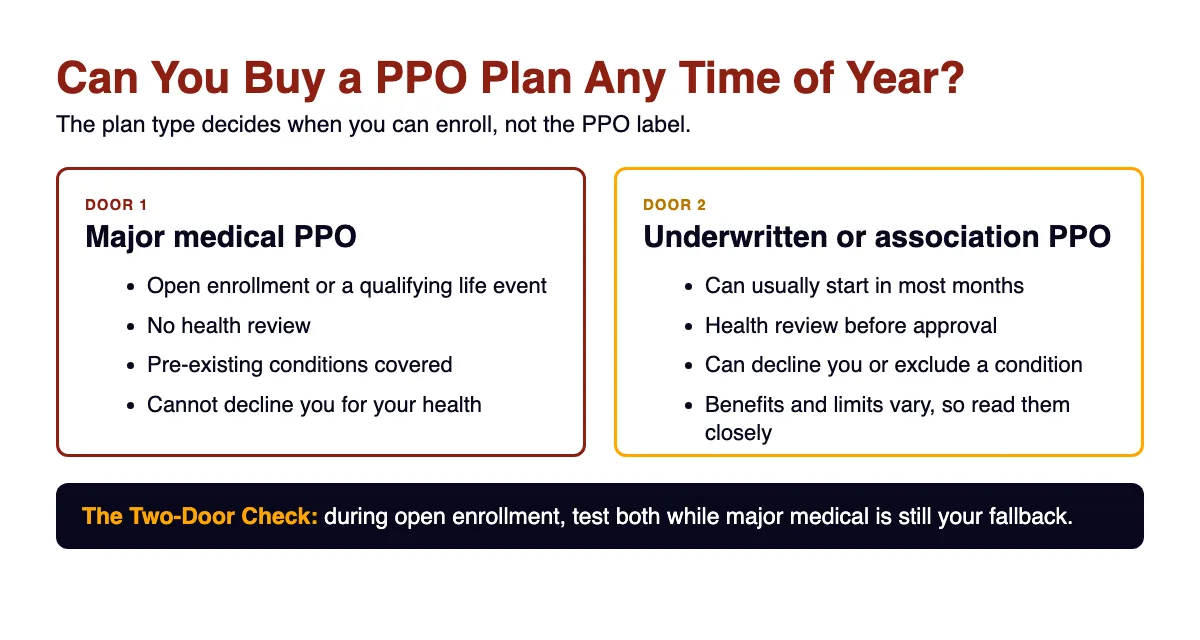
It depends on the type of private plan. Private major medical usually requires open enrollment or a qualifying life event. Underwritten private and association plans usually do not.
“Private” only tells you where the plan is sold. It does not tell you which rules apply to it.
KFF states that ACA-compliant plans sold outside the Marketplace are sold only during the annual open enrollment period. A qualifying life event is the main exception. So buying direct from a carrier does not get you around the calendar.
The federal reason is simple. The federal guaranteed availability rule requires these carriers to accept applicants, and it lets them limit enrollment to open and special enrollment periods.
Underwritten plans work on a different bargain. The carrier can review your health and say no, so it has no need for a calendar.
So can you buy a PPO plan any time of year from a private carrier? Only if it is the underwritten kind.
A useful rule of thumb: a plan that skips the calendar usually asks about your health. A plan that skips the health questions usually has a calendar.
What Is a PPO Plan, and Why Does the Label Cause Confusion?
A PPO, or preferred provider organization, is a plan with a contracted network that also pays something toward out-of-network care. You generally do not need a referral to see a specialist. Our comparison of HSA vs PPO vs HMO plans shows how the types differ.
Your costs are lowest inside the network. Going outside usually costs more, and you may be billed for the difference between the provider’s charge and what the plan allows.
The label is familiar because of work coverage. KFF’s 2025 Employer Health Benefits Survey found that 46% of covered workers are in a PPO, the most common plan type.
So many people leave a job expecting to buy “a PPO” as if it were one product. On the individual market, the same label can sit on plans with very different protections.
Always ask what kind of PPO a quote is for. That answer decides whether you can buy a PPO plan any time of year.
Which PPO Plans Can You Buy Any Time of Year?
Underwritten private plans, many association plans and some gap plans can start in most months. Major medical plans generally cannot, unless a qualifying life event opens a window for you.
| PPO route | Open enrollment needed? | Health review? | Pre-existing conditions | Best suited to |
| Major medical from a carrier | Yes, or a qualifying life event | No | Covered | Anyone with ongoing care needs |
| Underwritten or association plan | Usually no | Yes | May be declined or excluded | Healthy people who want a broad network |
| Short term plan with a PPO network | No | Usually yes | Usually excluded | Bridging a temporary gap |
| Employer group PPO | Follows the employer’s enrollment rules | No | Covered | Employees and small business owners |
If you need to buy a PPO plan any time of year, three details are worth knowing:
- Short term plans in Texas run from 30 days to 12 months. Read our short term health insurance guide for Texas before relying on one, or see every option for getting health insurance outside of open enrollment.
- Association plans are not open to everyone. Eligibility is confirmed first, and they often suit self-employed people and business owners. Here is how association health plans work.
- Employers can buy group coverage at any point during the year, with limited exceptions for small groups that miss contribution or participation rules. Employees still enroll under the employer’s own rules.
Availability varies by carrier, county and your health, so a quote confirms what is really open to you.
What Do You Give Up When a Plan Skips Open Enrollment?
You usually trade guaranteed acceptance and some protections for flexibility on timing. The monthly price may look better, but read the coverage line by line.
The freedom to buy a PPO plan any time of year has a cost, and it is rarely on the quote.
Check these before you apply:
- Acceptance. You can be declined, or offered a plan that excludes a condition.
- Covered benefits. Maternity, mental health or prescription coverage may be limited or left out.
- Spending limits. Ask about the out-of-pocket maximum and any annual or per-service caps.
- Renewal. Ask how the plan renews and how the rate can change.
- Coverage status. HealthCare.gov warns that most plans sold outside open enrollment do not count as qualifying health coverage.
If you decide to buy a PPO plan any time of year outside the window, check these points against the plan documents, not the sales summary.
For a healthy person who wants a specific network, that trade can make sense. For someone managing a condition, it often does not.
Why Can Leaving Major Medical Be a One-Way Door?
Dropping major medical for an underwritten plan may leave you without an easy way back until the next open enrollment. Canceling on purpose does not open a special enrollment period.
Federal rules exclude voluntary termination from what counts as a loss of coverage. The same rules tie that special enrollment trigger to losing minimum essential coverage.
Here is why that matters. Suppose your underwritten plan ends in the spring and it did not count as minimum essential coverage. Its ending may not give you a window to buy major medical.
Most guides selling year-round plans skip this point. It is the first thing we would want you to know.
Before you switch, ask two questions:
- Does this plan count as minimum essential coverage?
- If it ends mid-year, what are my options until open enrollment returns?
Get both answers in writing, and read our guide on whether you can cancel your health insurance during open enrollment before ending anything.
Why Is Open Enrollment the Best Time to Compare PPO Plans?
Because it is the one time both routes are open. You can apply for an underwritten PPO, see the result, and still choose guaranteed major medical if the answer disappoints you.
We call this the Two-Door Check:
- Door one: price major medical. Note the premium, network, deductible and out-of-pocket maximum.
- Door two: test an underwritten or association PPO. Apply and get the actual decision and final price. A quoted rate can change after a health review.
- Compare the real offers. Use the same doctors, the same prescriptions and a bad-year cost for both.
- Keep your current plan until the new one is confirmed. Cancel only after you have a start date in writing.
- Leave room before the deadline. Your fallback ends when the window closes. Here is what happens if you miss open enrollment.
Even when you can buy a PPO plan any time of year, starting early matters. Outside the window, a decline can leave you with short term coverage or waiting. Inside it, a decline just means you move to door one.
Can You Buy a PPO Plan Any Time of Year After a Life Event?
Yes. A qualifying life event opens a special enrollment period, usually 60 days, when you can buy major medical outside open enrollment, including a PPO if one is sold in your area.
Common events include losing job-based coverage, moving, marriage and having a baby. Our full list of qualifying life events covers the details.
The clock starts with the event itself, so act quickly. You may also be asked for proof, as our guide to the special enrollment period explains.
Leaving a job? Compare a new plan with your COBRA options before you decide.
Off-exchange carriers do not have to honor every Marketplace trigger, as the federal rule notes. Confirm that your event applies to the plan you want before you count on it.

Can an ICHRA Help You Buy a PPO Plan Mid-Year?
It can, if your employer offers one. An ICHRA gives you employer money toward your own individual coverage, and a new offer may open a special enrollment period.
An individual coverage HRA, or ICHRA, reimburses you for premiums and other medical costs. CMS now also calls it a CHOICE arrangement, and employers of any size may offer one. Your employer sets the amount, and you choose the plan.
The plan has to qualify. Federal rules require individual health insurance coverage, and short term plans do not count. Before you apply for an underwritten or association plan, ask in writing whether your ICHRA will accept it.
Check the timing and the tax credit too. CMS explains that a new offer may give you a special enrollment period tied to your HRA start date, and you cannot use a premium tax credit with the HRA.
Is a Private PPO Better Than a Marketplace Plan?
Neither is better for everyone. A private PPO can offer more network flexibility, while Marketplace plans are the only route to income-based savings. Your income, health and doctors decide it.
| If this describes you | What to compare first |
| Your income may qualify for savings | Marketplace plans, because premium tax credits are not available off the Marketplace |
| You have an ongoing condition | Major medical, because it cannot decline you or exclude the condition |
| You are healthy and your income is too high for savings | Underwritten and association PPOs next to major medical |
| You have specialists you will not give up | Whichever plan has them in network, confirmed by phone |
| You travel or split time between cities | Broad PPO networks, checked in each location |
In much of Texas, Marketplace plans lean toward HMO and EPO networks, so broader PPO choices are often found in private coverage. That is worth pricing, though it is not automatically the right fit. Self-employed? See the best health insurance for self-employed people.
How Much Does a PPO Plan Cost?
There is no single price. Your age, county, tobacco use, deductible and plan type all affect it, and underwritten plans can also price or accept you based on your health.
A PPO often costs more than an HMO with similar benefits, because you are paying for more freedom. Whether that is worth it depends on how much you use that freedom. Our Texas individual health insurance page shows the plan types we compare.
For a fair comparison, run three numbers for each plan:
- Light year: twelve premiums plus a few visits.
- Expected year: twelve premiums plus the care you already plan to use.
- Bad year: twelve premiums plus the out-of-pocket maximum, or the plan’s limits if it has no clear maximum.
Our guide on how to choose a health insurance plan walks through this method step by step.
Can You Join a PPO Mid-Year and Keep Your Deductible Credit?
Usually not. Deductible progress generally starts again at zero with a new plan, so a mid-year move can cost more than a lower premium saves.
This matters most if you have already had a costly year. Before you switch, compare what you have left to pay on your current plan with the full deductible on the new one.
Ask the new carrier how it treats amounts you have already paid, and get the answer before you switch. Our guide on whether you can change your health insurance plan after enrolling covers the rules.
How Can a Broker Help You Choose Without Pushing One Plan?
A licensed broker can compare major medical, underwritten and association options side by side, and check your doctors first. A good one will also tell you when a year-round plan is the wrong choice.
At Custom Health Plans, we compare PPO and private plans from top carriers across Texas. There is no fee for the help, because carriers pay brokers.
Whether you can buy a PPO plan any time of year is usually the first thing we check. A few questions show whether you are getting straight advice from any broker:
- Which carriers and plan types can you show me?
- Is this plan major medical? If not, what does it not cover?
- What happens if I am declined, or if this plan ends mid-year?
- Have you confirmed my doctors with the network for this exact plan?
The honest limit: no broker can get you approved for an underwritten plan or create a qualifying life event. If major medical is the better fit for you, that should be the recommendation.
The Bottom Line
You can buy a PPO plan any time of year only with certain plans, and those plans usually come with a health review and real trade-offs.
- The PPO label does not set the enrollment rules. The plan type does.
- Private major medical generally follows open enrollment.
- Underwritten and association PPOs can start in most months, if you qualify.
- Check coverage status and your way back before leaving major medical.
- Use open enrollment to test both doors while your fallback is still open.
Want to see both options next to each other? Call (469) 361-4032 or request a free quote. We can check your doctors and prescriptions first, then walk through what fits. There is no fee and no obligation.