
If you missed open enrollment for health insurance, you are not locked out. You can buy a full ACA plan if you had a qualifying life event in the last 60 days, apply for Medicaid or CHIP any month, or buy plans that are not tied to open enrollment. Those include private PPO plans through a trade or association (ERISA) plan if you are self-employed or run a small business, plus short-term and fixed indemnity coverage.
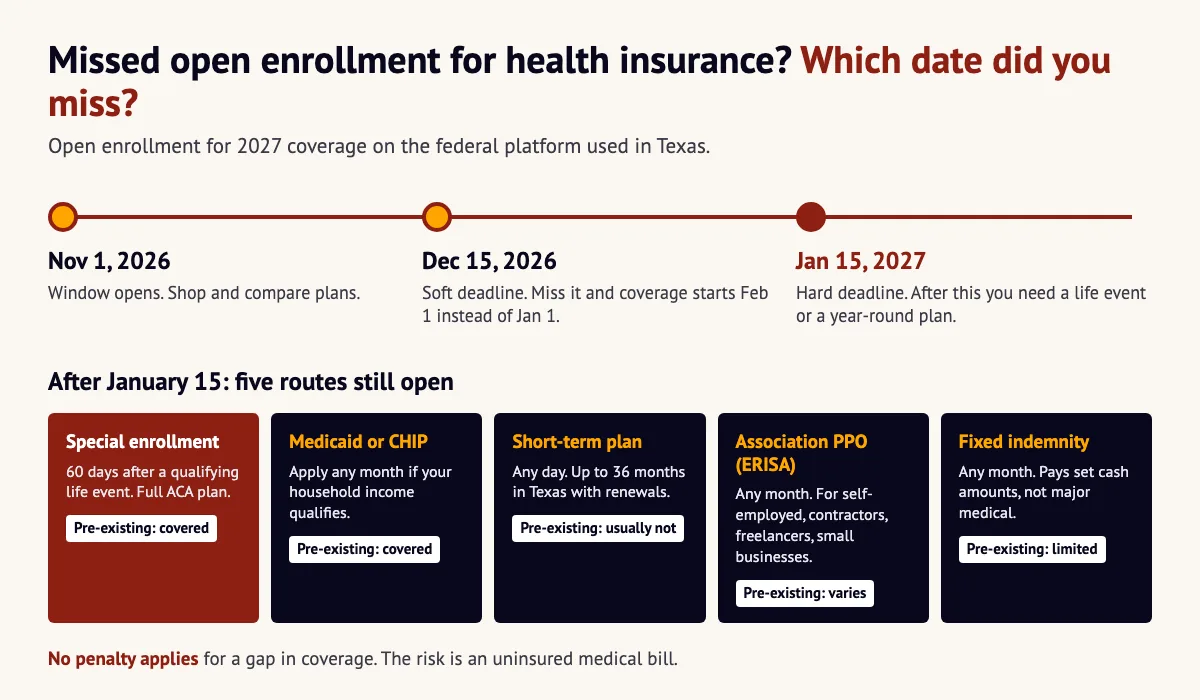
The next open enrollment for 2027 coverage runs November 1, 2026 to January 15, 2027. Pick a plan by December 15, 2026 for coverage that starts January 1.
This guide covers what actually happens after the window closes, every route still open to you, what each one costs, and how to decide between buying now and waiting.
Key takeaways:
- No penalty. The federal fine for being uninsured has been $0 since 2019, and Texas has no state mandate.
- 60 days. A qualifying life event opens a special enrollment period for a full ACA plan.
- Any month: Medicaid, CHIP, short-term, fixed indemnity, and private PPO plans through a trade or association (ERISA) plan.
- Self-employed or a small business? An association PPO plan is often the strongest year-round option.
- Trade-off: most year-round private options do not cover pre-existing conditions.
- Next window: November 1, 2026 to January 15, 2027.
What Happens If You Missed Open Enrollment for Health Insurance?
If you missed open enrollment for health insurance, you cannot buy an ACA major medical plan until the next window opens, unless a qualifying life event gives you a special enrollment period. That rule applies to plans bought directly from a carrier, not only to the Marketplace.
Nothing else happens. There is no fine, no mark on your record, and no letter from the IRS.
What you lose is the right to buy a plan that must accept you regardless of your health. Until the next window, your options depend on your life events, your income and your health.
The four routes that stay open:
| Route | When you can enroll | Covers pre-existing conditions? | Best for |
| Special enrollment period (ACA plan) | 60 days after a qualifying life event | Yes | Anyone with a recent life change |
| Medicaid or CHIP | Any month | Yes | Income-eligible adults, children, pregnant women |
| Short-term health insurance | Any day, often starts the next day | Usually no | Healthy people bridging a gap |
| Private PPO through a trade or association (ERISA) plan | Any month | Depends on the plan | Self-employed, independent contractors, freelancers, small businesses |
| Fixed indemnity plans | Any month | Usually limited | Budget cover with known trade-offs |
What Happens If You Accidentally Miss Open Enrollment?
If you already had a Marketplace plan last year, you may not have missed anything. Returning enrollees are usually re-enrolled automatically into the same plan, or a similar one, if they do nothing.
Check before you panic. Log in to your account or call your carrier and ask whether you have active coverage for the new year.
If you had no plan at all, an accidental miss is treated the same as a deliberate one. Forgetting, being busy or not knowing the dates is not a qualifying event.
There is one narrow exception. If you missed the deadline because of an error by the Marketplace, an enrollment assister or a natural disaster, you can ask for an exceptional circumstances special enrollment period. These are granted case by case, so apply quickly and keep records.
What Happens If I Miss My Enrollment Date?
It depends which date you missed. Open enrollment has two deadlines, and missing the first one is far less serious than missing the second.
| You picked a plan | Your coverage starts |
| November 1 to December 15, 2026 | January 1, 2027 |
| December 16, 2026 to January 15, 2027 | February 1, 2027 |
| After January 15, 2027 | Only with a qualifying life event, or next open enrollment |
Missing December 15 costs you one month of coverage, not the year. You can still enroll until January 15 and start February 1.
Missing January 15 is the real deadline, and it is what most people mean when they say they missed open enrollment for health insurance. After that, you need a qualifying life event or one of the year-round options below.
Dates come from healthinsurance.org’s open enrollment guide, which tracks the federal schedule. Some states that run their own exchange set different end dates. Texas uses the federal platform, so these dates apply here.
How Do I Get Health Insurance If I Missed the Enrollment Period?
Work through three checks in order. The first one that applies to you is usually your best route.
- Did you have a qualifying life event in the last 60 days? If yes, you can buy a full ACA plan now.
- Is your household income low enough for Medicaid or CHIP? If yes, apply now. There is no enrollment window.
- Neither? If you are self-employed, a contractor, a freelancer or a small business owner, price a private PPO through an association plan. Otherwise compare short-term and fixed indemnity plans, or wait for November.
Most people stop at step one too early. They assume they do not qualify, when a job change, a move or a lost plan in the last two months would have opened a window.
What Counts as a Qualifying Life Event?
A qualifying life event is a major change that gives you a special enrollment period, usually 60 days, to buy a plan outside open enrollment. The HealthCare.gov special enrollment page lists the main ones.
- Losing health coverage, such as job-based coverage, COBRA running out, or losing Medicaid or CHIP. See health insurance between jobs in Texas.
- Moving to a new ZIP code or county with different plans.
- Getting married or divorced, if the divorce costs you coverage.
- Having a baby, adopting or fostering a child.
- Turning 26 and ageing off a parent’s plan. Our turning 26 guide covers the deadlines.
- Gaining citizenship or lawful presence, or release from incarceration.
Some events let you apply up to 60 days before the event, such as a known job end date. Applying early avoids a gap.
What does not qualify: dropping a plan on purpose, being cancelled for not paying premiums, or simply deciding you now want coverage.
How Long Do You Have to Prove a Qualifying Event?
You usually get 30 days after choosing a plan to send proof of the event. This step is where many special enrollment applications fail.
Applications are rarely denied because the event did not qualify. They stall because the paperwork never arrives.
| Event | Proof that usually works |
| Lost job-based coverage | Letter from employer or insurer showing the end date, or a COBRA notice |
| Marriage | Marriage certificate |
| Birth or adoption | Birth certificate, hospital record or placement papers |
| Moved | New lease or mortgage statement, plus proof of the old address |
| Turned 26 | Document showing the parent’s plan and the date your coverage ended |
Gather documents the same week. The 60-day clock does not pause while you look for them.
Can I Still Get Insurance If Open Enrollment Is Ended?
Yes. If you missed open enrollment for health insurance, several kinds of coverage have no enrollment window at all. The trade-off is that the private ones can ask health questions and usually exclude pre-existing conditions.
Medicaid and CHIP accept applications every month. CHIP covers many Texas children in working families, and some pregnant women.
Short-term health insurance can be bought any day, and coverage often starts the next day. Texas allows these plans to run up to 36 months in total, including renewals, after the Department of Labor paused enforcement of the federal four-month cap in August 2025.
Fixed indemnity plans pay a set cash amount per doctor visit, hospital day or procedure. They are not major medical and have no out-of-pocket maximum.
Private PPO plans through a trade or association (ERISA) plan can be bought any month of the year. They are built for self-employed people, independent contractors, freelancers and small businesses, who join through a trade or professional association.
Because these are group plans governed by the federal ERISA law, they are not tied to the individual open enrollment calendar. Many include broad PPO networks, so you can see doctors and specialists without referrals.
Eligibility and underwriting rules vary by plan, and some ask health questions before approval. A broker can confirm which association plans you qualify for and how they compare.
Employer coverage through a spouse may also open if your spouse’s employer offers a mid-year window after a life event.
How Much Does Coverage Cost If You Missed Open Enrollment?
If you missed open enrollment for health insurance and have no qualifying event, short-term coverage is the most common bridge. In Texas it typically runs $80 to $300 a month for a healthy adult, depending on age, deductible and plan design. The ranges below are estimates, not quotes.
| Age | Typical short-term premium per month |
| 25 to 29 | $80 to $150 |
| 30 to 39 | $100 to $200 |
| 40 to 49 | $150 to $275 |
| 50 to 59 | $250 to $400 |
| 60 to 64 | $350 to $500+ |
For comparison, ACA plans became much more expensive for many Texans. The enhanced premium tax credits expired at the end of 2025, and KFF estimated average premium payments would more than double, from $888 to $1,904 a year.
Prices keep climbing. Insurers proposed a median 15% increase for 2027, on top of an 18% median rise for 2026. As of October 2026, Congress has not restored the enhanced credits.
That shift cuts both ways. A plan that looked too expensive to bridge two years ago may now be the cheaper choice for a healthy person.
What If You Missed Open Enrollment for Health Insurance and Have a Pre-Existing Condition?
If you missed open enrollment for health insurance and you have an ongoing condition, avoid relying on short-term coverage. These plans can deny claims linked to a condition you had before the policy started.
Your safer routes, in order:
- A qualifying life event, if one happened in the last 60 days. ACA plans must cover pre-existing conditions.
- COBRA, if you recently left a job. It keeps the same plan and doctors, at full cost plus a 2% fee. Compare it first with our COBRA alternatives in Texas.
- Medicaid or CHIP, if your income qualifies.
- A spouse’s employer plan, if a life event opened their window.
- Next open enrollment, starting November 1, 2026.
The Texas Department of Insurance warns that some alternative plans review your medical history only after you file a claim. Read the exclusions before you buy.
Is There a Grace Period After Open Enrollment?
No. There is no grace period for enrolling once open enrollment closes on January 15. After that date, the system will not let you buy a plan without a qualifying life event.
People often confuse this with the premium payment grace period, which is different. It protects you if you are already enrolled and miss a payment.
- With premium tax credits, you generally get 3 months to catch up before coverage ends.
- Without them, the grace period is usually shorter, often about a month. Check your policy.
Losing coverage for unpaid premiums does not create a special enrollment period. Keep payments current if you already have a plan.
Is Open Enrollment Extended for 2026 or 2027?
Open enrollment for 2026 coverage closed on January 15, 2026 and was not extended. The window for 2027 coverage keeps the familiar dates: November 1, 2026 to January 15, 2027.
Many websites still say the 2027 window ends on December 15. That was the plan under a 2025 federal rule, but a federal court struck down that provision in June 2026, and CMS confirmed this summer that HealthCare.gov will stay open through January 15.
The government has appealed. The appeal does not change this year’s dates.
Two other rule changes matter if you missed open enrollment for health insurance:
- The monthly low-income special enrollment period for households under 150% of the poverty level is gone. CMS confirms it ended in August 2025 and stays closed through 2026.
- Lower-income Texans can no longer count on a rolling window. Medicaid, CHIP and a qualifying event are the remaining paths.
What If You Missed Open Enrollment at Work?
Employer plans run their own open enrollment, usually in the fall, and set their own dates. If you missed open enrollment at work, you generally wait until next year’s window.
The exception is a life event. Federal rules require employer plans to allow special enrollment for events such as marriage, birth, adoption or losing other coverage.
The window is shorter than the Marketplace’s. It is usually 30 days from the event, or 60 days if you lost Medicaid or CHIP. Ask HR the same week.
If your employer plan is closed to you, an individual plan is still an option during a qualifying event, or a short-term plan can bridge you to the next window.
Missed Open Enrollment for Health Insurance: Should You Buy Now or Wait?
If you missed open enrollment for health insurance this year, the next window is only weeks away, so waiting is often the cheaper choice for healthy people. The answer changes with your health and how long the gap is.

| Your situation | Usually the better move |
| Healthy, gap of 1 to 3 months | Bridge with short-term, or wait for January 1 |
| Self-employed, contractor, freelancer or small business owner | Price a private PPO through an association (ERISA) plan now |
| Healthy, gap of 6+ months | Price short-term or an association plan seriously |
| Ongoing condition or regular prescriptions | Find a qualifying event, COBRA or Medicaid. Avoid relying on short-term |
| Recent job loss | Compare COBRA against an ACA plan through your special enrollment period |
| Low income | Apply for Medicaid or CHIP now |
The honest limitation: short-term and fixed indemnity plans are not major medical. They can cost less, but they cover less, and they will not pay for a condition you already have.
Going bare is the most expensive gamble of all. A single emergency room visit can run into thousands of dollars, and an uninsured patient pays the full billed rate.
Why Does Missing Open Enrollment Hit Texans Harder?
Texas has the highest uninsured rate in the country: 16.7%, against 8.0% nationally, according to Texans Care for Children.
Texas has not expanded Medicaid. The income limit for parents is about 15% of the poverty level, roughly $4,098 a year for a family of three.
So in Texas, the safety net that catches people in other states is often not there. If you missed open enrollment for health insurance here, choosing the right bridge matters more.
What Should You Do Next?
If you missed open enrollment for health insurance, use the next 15 minutes to sort out which route applies to you.
- List life changes from the last 60 days. Job, move, marriage, baby, lost coverage, turning 26.
- Check Medicaid and CHIP eligibility for everyone in your household.
- Price a bridge plan if you have no qualifying event, and read the exclusions.
- Mark November 1, 2026 in your calendar, and December 15 for a January 1 start.
A licensed broker can run all four checks in one call and compare private plans from top carriers side by side. The comparison costs you nothing.
For the full picture on enrollment dates, read our Texas open enrollment guide. For life-event rules, see our guide to the special enrollment period.
Closing thoughts
Having missed open enrollment for health insurance changes which plans you can buy. It does not leave you without options.
- Check for a qualifying life event first. It is the only way to a full ACA plan before January.
- Medicaid and CHIP never close.
- Self-employed or a small business? A private PPO through an association (ERISA) plan is available any month.
- Short-term and indemnity plans exist year round, but most exclude pre-existing conditions.
- December 15 is the soft deadline. January 15 is the hard one.
- No penalty applies, but an uninsured medical bill can.
Custom Health Plans is a Texas brokerage. If you want your options compared for your situation, call (469) 361-4032 or request a free quote.