
Quick answer: Health insurance open enrollment is the yearly window when anyone can buy or switch an individual health plan without needing a special reason. For 2027 coverage it runs November 1, 2026 through January 15, 2027. Enroll by December 15 to start on January 1. Outside this window you need a qualifying life event, or a plan type that is not tied to open enrollment.
Open enrollment is the one time of year the door is open to everyone. No health questions. No waiting for a life event.
This guide covers the 2027 dates, what changed twice this year, the three ways you can enroll, and how to pick a plan without guessing.
Key takeaways:
- Open enrollment for 2027 coverage runs November 1, 2026 to January 15, 2027.
- The deadline for January 1 coverage is December 15, 2026. Later enrollments start February 1.
- The end date was changed twice. Some sites still print the old December 15 end date.
- Costs are moving a lot this year. Marketplace rates rose a median 15% for 2027.
- Texas has the highest uninsured rate in the country at 16.7%.
If You’re in a Rush
- Mark two dates: December 15 for January 1 coverage, January 15 to enroll at all.
- Check your renewal letter. Your plan may have changed even if you did nothing.
- Do not assume the Marketplace is your only option. Private PPO and association plans sit outside it.
- If you get a subsidy, it only works through the Marketplace. That matters more this year than last.
- If you miss January 15, you need a qualifying life event or a plan not bound by open enrollment.
- Want a second set of eyes before you pick? A Texas broker can compare your options at no cost. Call Custom Health Plans at (469) 361-4032.
What Is Health Insurance Open Enrollment?
Health insurance open enrollment is a fixed annual window when you can enroll in, switch, or drop an individual health plan for any reason at all.
Outside that window, insurers do not have to sell you a major medical plan. That is the whole point of the window.
During open enrollment, a carrier cannot turn you down for a health condition and cannot charge you more for one. They also cannot ask about your medical history.
You can change your mind as many times as you like before the deadline. Only the last plan you pick counts.
Three things are true only during open enrollment:
- Guaranteed acceptance. No medical underwriting on major medical plans.
- Free switching. Move between carriers or plan levels with no penalty.
- Subsidy eligibility check. Marketplace premium tax credits are set for the year.
Employer plans run their own separate window, usually in the fall. Medicare runs its own too, from October 15 to December 7. This guide covers individual and family coverage you buy yourself.
When Is Open Enrollment for 2027 Coverage?
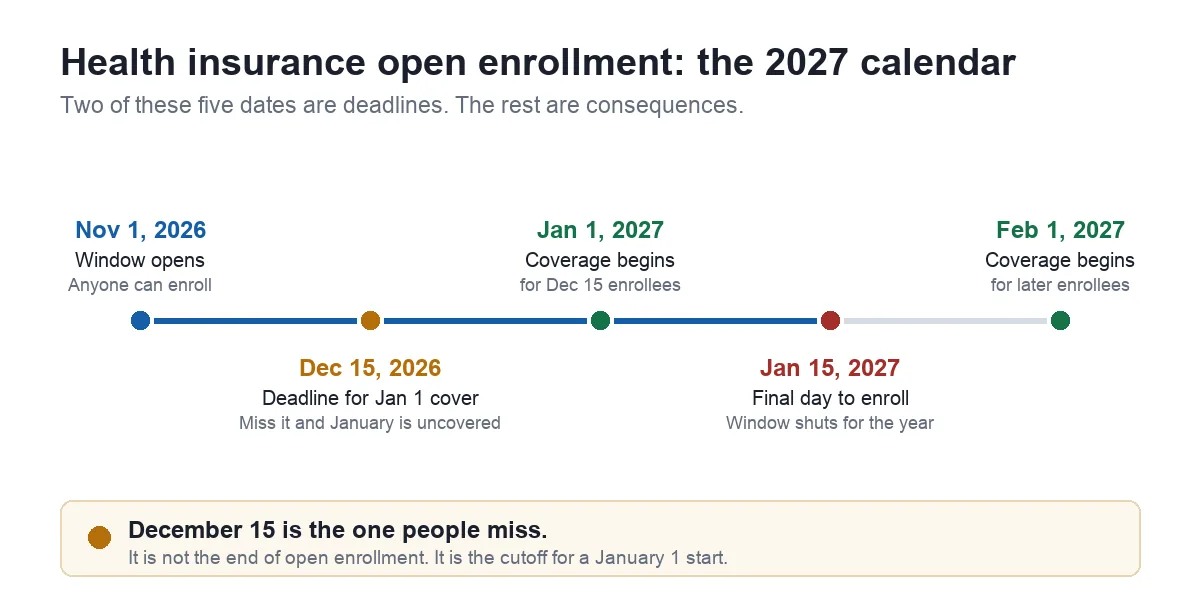
Open enrollment for 2027 coverage runs November 1, 2026 through January 15, 2027 on the federal Marketplace. Texas uses the federal Marketplace, so these are the Texas dates.
Here is how the calendar actually works.
| Date | What it means |
|---|---|
| November 1, 2026 | Window opens. You can browse, compare and enroll. |
| December 15, 2026 | Last day to enroll for coverage starting January 1, 2027. |
| January 1, 2027 | Coverage begins for anyone who enrolled by December 15. |
| January 15, 2027 | Final day to enroll at all. |
| February 1, 2027 | Coverage begins for anyone who enrolled December 16 to January 15. |
The December 15 date is the one people miss. It is not the end of open enrollment. It is the cutoff for a January 1 start.
Enroll on December 20 and you are still enrolled, but you have no coverage for the whole of January. Each of those dates does something different, and when open enrollment opens for 2027 takes them one at a time.
Every date here applies to plans you buy yourself. Your employer sets its own window.
Why Did the 2027 Open Enrollment Dates Change Twice?
The end date for 2027 changed twice in about a year, which is why you will still find sites printing the wrong one.
Here is the sequence.
The 2025 Marketplace Integrity and Affordability final rule shortened federal Marketplace open enrollment to November 1 through December 15, starting with plan year 2027, according to the American Hospital Association.
A federal court then vacated that December 15 provision in June 2026.
In July 2026, CMS confirmed the federal Marketplace would run November 1, 2026 through January 15, 2027 after all, as healthinsurance.org reports.
So the real 2027 end date is January 15, 2027.
Why this matters to you: a guide published in 2025 may tell you the window closes December 15. Acting on that costs you a month of enrollment time.
If a page does not show a “last updated” date from mid 2026 or later, check its dates against an official source before you trust them. If it is the year now ending you actually need, the 2026 open enrollment dates are a separate set again.
What Are Your Three Ways to Enroll?
You can enroll on your own through HealthCare.gov, with a navigator, or with a licensed broker. Each covers different ground and costs you a different amount of time.
Here they are compared straight.
| On your own | Navigator | Licensed broker | |
|---|---|---|---|
| What it costs you | Free | Free | Free to you. Paid by the carrier. |
| Shows Marketplace plans | Yes | Yes | Yes |
| Shows off-exchange plans | No | No | Yes |
| Can recommend a specific plan | n/a | No | Yes |
| Helps with subsidies | Yes, self-serve | Yes | Yes |
| Helps later with claims or billing | No | Limited | Usually yes |
| Available year round | Yes | Mostly at season | Yes |
A few things worth knowing about each.
- HealthCare.gov shows on-exchange plans only. That is the full subsidized market, and nothing outside it.
- Navigators are trained and free. By design they give unbiased help but cannot recommend a specific plan to you.
- Brokers are licensed and paid by carriers, not by you. They can show both on-exchange and off-exchange options and can tell you which they would pick.
The honest limitation: a broker can only place carriers they are appointed with. No broker represents every carrier in Texas. Ask which ones they hold before you start, so you know the edges of what you are being shown.
What Is the Difference Between Marketplace and Private Plans?
Marketplace plans are ACA plans sold on HealthCare.gov, and they are the only place premium tax credits can be applied. Private plans are sold off the exchange, directly through carriers and brokers.
Both are real coverage. They serve different people.
Marketplace plans make sense when you qualify for a subsidy. The tax credit only exists on the exchange, so if you are eligible, buying off-exchange means paying full price on purpose.
Off-exchange private plans make sense when you do not qualify, or when the exchange networks in your county do not include your doctors. Many are PPO plans with wider networks than the HMOs that dominate the Texas exchange.
Association health plans are a third route. These let individuals and small groups access coverage through a membership organization. You can read more on our association health plans page.
This is the year that distinction got sharper. Enhanced premium tax credits expired at the end of 2025.
KFF estimated that would push average Marketplace premium payments up 114%, from $888 to $1,904 a year.
If your subsidy shrank or disappeared, the maths that made the exchange obviously cheapest may no longer hold. It may still hold. It is worth checking both sides rather than assuming.
How Much Will Health Insurance Cost in 2027?
Marketplace premiums are rising for a second straight year. Insurers proposed a median 15% increase for 2027, the second consecutive year of double digit rises.
The detail is in the Peterson-KFF Health System Tracker analysis of 276 insurers.
- Proposed changes range from -1% to 54%. Most, about 63%, fall between 10% and 25%.
- The 2027 median of 15% follows an 18% median increase for 2026.
- Median medical trend hit 10%, above the 8% typical of recent years.
- Insurers attribute about 4 percentage points of the 2027 rise to a sicker risk pool after healthier people dropped coverage.
- One Texas insurer built in a 6.0% morbidity adjustment for expected market contraction.
A worked example from the same analysis: a 40 year old in Indiana earning $65,000 would go from $316 a month in 2025 to $546 in 2027, a 41% rise over two years.
Your own number will differ by age, county and plan. Rate filings are also proposals, and final approved rates can land lower.
The practical takeaway is simple. Do not auto-renew on the assumption your price held.
What Happens If You Do Nothing During Open Enrollment?
If you do nothing, most Marketplace plans auto-renew you into the same plan or the closest one the carrier still offers. You stay covered, but not always on the terms you had.
Auto-renewal is a real safety net. It is also where people get quietly repriced.
Three things can change without you doing anything:
- Your premium. Rates reset each January.
- Your subsidy. It is recalculated from the income on file, which may be stale.
- Your plan itself. If your plan is discontinued, you get mapped to a replacement with a different network or drug list.
Your carrier mails a plan change notice in the fall explaining exactly this. It arrives with everything else in October and November, which is why it goes unread.
The broker angle here is small but real: someone reads that notice with you and tells you in plain words what changed.
The honest limitation: that notice comes to you directly. You can read it yourself, and if your plan did not change and you are happy with it, auto-renewal is a perfectly fine outcome.
Do All Health Insurance Plans Have Open Enrollment?
No. Open enrollment governs major medical plans, both on and off the exchange. Several other coverage types can be bought any month of the year.
This is the part most guides skip, and it is the difference between “wait until November” and “you have options now”.
Plans not bound by open enrollment include:
- Short term health insurance. Bridge coverage, bought any time. See our short term health insurance in Texas guide.
- Fixed indemnity plans. Pay set cash amounts per service. More on our fixed indemnity page.
- Association health plans, depending on the association’s own rules.
- Dental and vision plans, generally.
- Medicaid and CHIP. Year round if you qualify.
The honest limitation, and it matters: short term and fixed indemnity plans are not major medical. They are not ACA compliant. They can exclude pre-existing conditions and may carry no out of pocket maximum.
They solve a gap. They are not a substitute for a comprehensive plan when you can get one.
We cover the full picture in health insurance alternatives in Texas.
What If You Miss Open Enrollment?
If you miss January 15, you generally wait until the next open enrollment unless you qualify for a special enrollment period. A qualifying life event opens a 60 day window to enroll, and which of the two windows you are in decides everything, so the difference between open enrollment and special enrollment is worth being clear on.
HealthCare.gov confirms the window runs 60 days before or after the event.
Qualifying life events include losing coverage, moving, marriage, having or adopting a baby, divorce, turning 26, and losing Medicaid or CHIP.
If no event applies, the non-major-medical options above are still open to you.
We go deeper in missed open enrollment in Texas and health insurance after open enrollment.
The honest limitation: if you are subsidy eligible and you can safely wait for January 1, waiting is often genuinely cheaper than buying a stopgap. That is a real answer, not a brush off.
How Should You Choose a Plan This Open Enrollment?
Work in this order: your doctors first, then your prescriptions, then your likely total cost for the year, then the premium. Premium last is deliberate.
The cheapest premium is rarely the cheapest year.
- List your doctors. Check each against the plan’s network directory. Confirm on the carrier’s own site, not a comparison tool.
- List your prescriptions. Find each on the plan’s formulary and note the tier.
- Estimate your year. Premium times 12, plus the deductible you would realistically hit, capped by the out of pocket maximum.
- Compare PPO against HMO. An HMO usually costs less and requires referrals. A PPO costs more and travels better.
- Then look at the premium. By now you know what you are buying.
For a fuller walkthrough of the Texas market, see our Texas individual health insurance page.
The honest limitation: every step above is something you can do yourself. It takes roughly an evening per plan you are seriously considering. What a broker saves you is the evenings, not the ability.
Why Does Open Enrollment Matter So Much in Texas?
Texas has the highest uninsured rate of any state, and the gap is not close. That makes the annual window more consequential here than in most places.
Texans Care for Children reports the 2024 figures:
- Texas uninsured rate: 16.7%, against 8.0% nationally.
- Texas adults aged 19 to 64: 21.6% uninsured.
- Texas children: 13.6% uninsured, versus 6.0% nationally.
- Texas has not expanded Medicaid. The threshold for parents sits at 15% of the federal poverty level, about $4,098 a year for a family of three.
That last point is the one that surprises people. A Texas parent earning more than roughly $342 a month can be over the Medicaid line and still far from comfortable.
For many Texans, the individual market during open enrollment is not one option among several. It is the option.
Conclusion
Health insurance open enrollment for 2027 runs November 1, 2026 to January 15, 2027, with December 15 as the cutoff for January 1 coverage.
- Two dates matter. December 15 for a January start. January 15 to enroll at all.
- Check the end date on anything you read. It was changed twice and many pages are stale.
- Read your renewal notice. Auto-renewal keeps you covered, not necessarily on the same terms.
- Subsidy eligible? Compare on the Marketplace. Not eligible? Compare off-exchange too.
- Doctors and prescriptions first. Premium last.
If you want someone to check your plan against what else is available in your county, Custom Health Plans is a Texas brokerage and the review costs nothing. Call (469) 361-4032 or request a quote.