
When is open enrollment for health insurance 2026? It depends which year you mean. The window opening November 1, 2026 buys coverage for 2027 and runs through January 15, 2027. Coverage for 2026 itself was bought in a window that closed on January 15, 2026, and can now only be started with a qualifying life event.
“Open enrollment 2026” means two different things depending on who is saying it, which is why the search results disagree with each other.
This page sorts out which window you actually need, then tells you exactly what to do in each case.
Key takeaways:
- Enrolling in November 2026 buys 2027 coverage. That is the next window.
- The window for 2026 coverage has already closed. It ended January 15, 2026.
- Need coverage right now in 2026? You need a qualifying life event, or a plan not tied to open enrollment.
- The next window runs November 1, 2026 to January 15, 2027.
- Employer and Medicare windows are different dates again, and they are running this fall.
If You’re in a Rush
- Planning ahead for next year? Your window is November 1, 2026 to January 15, 2027.
- Need coverage today? Check whether you have had a qualifying life event in the last 60 days.
- No qualifying event? Short term, fixed indemnity and association plans are not tied to open enrollment.
- On a job based plan or Medicare? Your window is a different set of dates. See the section below.
- Already covered and just renewing? Read your renewal notice when it arrives in the fall.
- Not sure which situation you are in? Custom Health Plans can sort it out in one call. Call (469) 361-4032.
When Is Open Enrollment for Health Insurance 2026?
The confusion comes from a simple mismatch. You enroll in one calendar year for coverage in the next one.
So “open enrollment 2026” can mean the enrollment that happens during 2026, or the coverage year of 2026. They are twelve months apart.
Use this to find yourself.
| What you want | Which window | Dates |
|---|---|---|
| Coverage starting January 2027 | The next open enrollment | Nov 1, 2026 to Jan 15, 2027 |
| Coverage for the rest of 2026 | That window has closed | Ended Jan 15, 2026 |
| Coverage starting as soon as possible | Special enrollment, or a non-ACA plan | Depends on your situation |
Almost everyone searching this in the second half of 2026 wants the first row. The enrollment happens in 2026. The coverage it buys is for 2027.
The rest of this page follows those three paths in order.
When Can You Enroll for 2027 Coverage?
Open enrollment for 2027 coverage runs November 1, 2026 through January 15, 2027. Texas uses the federal Marketplace, so these are the Texas dates.
| Date | What happens |
|---|---|
| November 1, 2026 | Window opens. 2027 plans and prices go live. |
| December 15, 2026 | Last day to enroll for a January 1, 2027 start. |
| January 15, 2027 | Final day to enroll. Coverage starts February 1. |
The December 15 date is the one that costs people a month, because it is not the end of the window. It is the cutoff for a January 1 start.
Worth verifying this end date wherever you read it. It was changed twice.
The 2025 Marketplace Integrity and Affordability final rule shortened the window to close December 15 from plan year 2027, as the American Hospital Association reported.
A federal court vacated that provision in June 2026, and CMS confirmed a January 15 close, per healthinsurance.org.
For a fuller walkthrough of the coming window, see when is open enrollment for health insurance 2027. For everything the window covers, from subsidies to plan types, start with our complete guide to health insurance open enrollment.
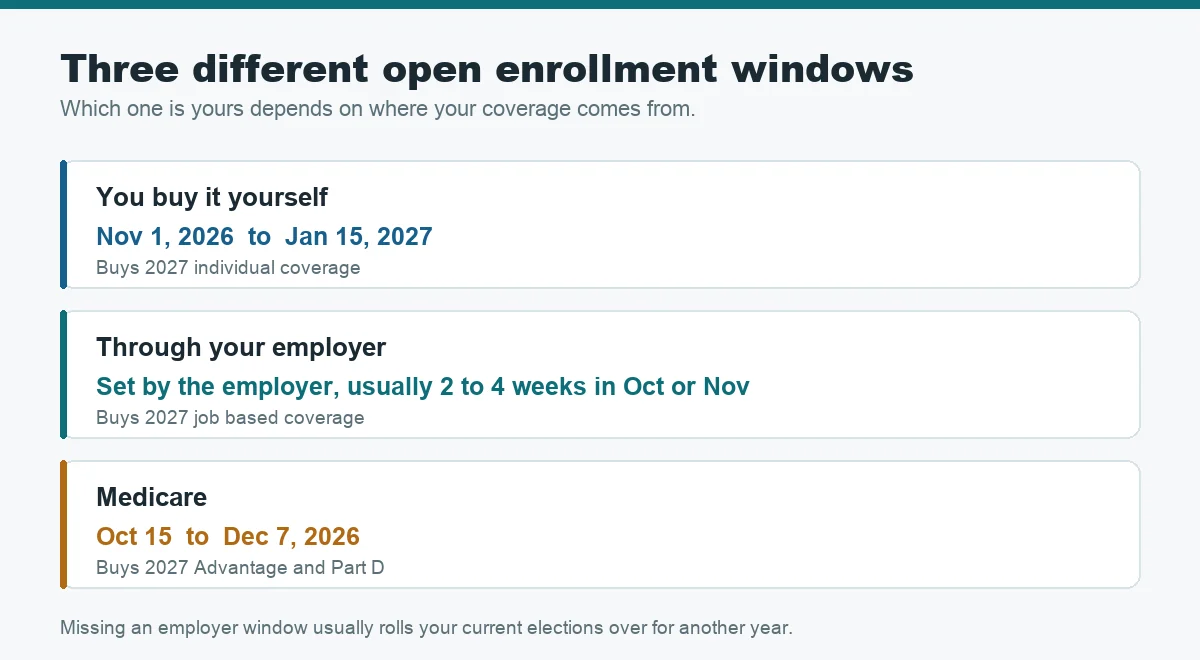
Are You Looking for Your Employer Plan or Medicare?
If you get coverage through a job, or you are on Medicare, none of the dates above are yours. Both run separate windows, and both of them are happening this fall.
This is the second most common reason people land on the wrong page.
| Where your coverage comes from | Your 2026 window | What it buys |
|---|---|---|
| You buy it yourself | Nov 1, 2026 to Jan 15, 2027 | 2027 individual coverage |
| Your employer | Set by the employer, usually 2 to 4 weeks in Oct or Nov | 2027 job based coverage |
| Medicare | Oct 15 to Dec 7, 2026 | 2027 Medicare Advantage and Part D |
Employer plans. Your company picks its own window and it is often short. Payroll or HR sends the dates, and missing them generally means your current elections roll over for another year, including the ones you meant to change.
Medicare. The annual window runs October 15 to December 7 every year. This is when you can switch between Original Medicare and Medicare Advantage, or change a Part D drug plan.
If you are turning 65, that is a different window again, built around your birthday rather than the calendar.
The one that catches people out: if your employer offers you affordable coverage, taking a Marketplace plan instead usually means giving up the premium tax credit. Check what work is offering before you shop.
Is It Too Late to Get Health Insurance for 2026?
For a standard ACA plan starting mid 2026, yes. That window closed on January 15, 2026. But two routes remain open.
This is the honest answer, and it is better than the vague one.
Route one: a qualifying life event. If something on the federal list has happened to you in the last 60 days, you can still enroll in a full ACA plan. HealthCare.gov confirms the 60 day window.
Qualifying events include losing coverage, moving, marriage, divorce, having a baby, turning 26, and losing Medicaid or CHIP.
Route two: coverage not bound by open enrollment. Several plan types can be bought any month:
- Short term health insurance
- Fixed indemnity plans
- Association health plans
- Medicaid and CHIP, year round if you qualify
Be clear about the trade on route two. Short term and fixed indemnity plans are not ACA compliant major medical. They can exclude pre-existing conditions and may have no out of pocket maximum.
They fill a gap until January. They do not replace comprehensive coverage.
We cover this fully in missed open enrollment in Texas.
What Does Your Renewal Notice Actually Tell You?
If you already have coverage, your carrier mails a plan change notice in the fall. It explains exactly what is happening to your plan in the coming year.
It arrives with everything else in October and November, which is precisely why it goes unread.
Three things in it are worth finding:
- Your new premium for the coming year.
- Whether your plan is continuing or being discontinued and replaced.
- Changes to your network or drug list, which are easy to skim past.
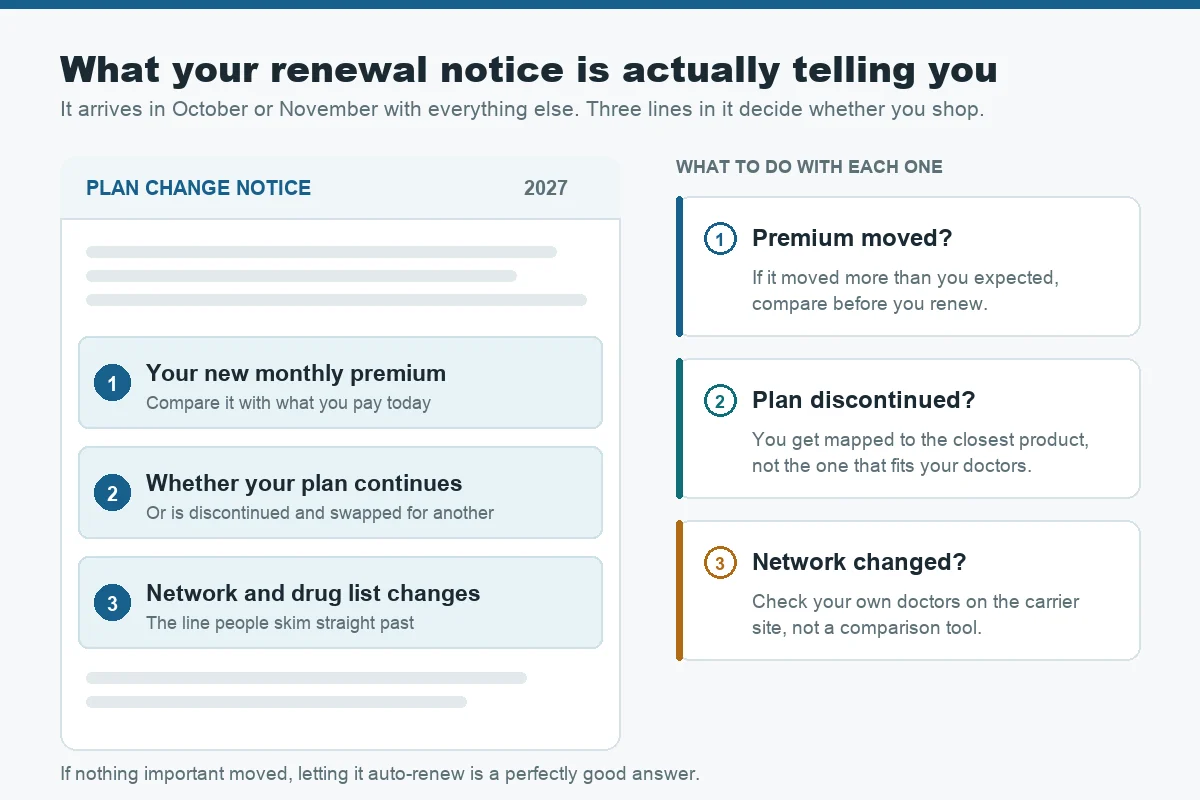
If your plan is being discontinued, you are usually mapped automatically to a replacement. That replacement is chosen for being the closest available product, not for matching your doctors.
The broker angle: someone reads that notice with you and tells you in plain words what changed and whether it matters.
The honest limitation: the notice comes to you directly. You can read it yourself, and if nothing important moved, doing nothing is a perfectly good answer.
Will Health Insurance Go Up in 2027?
For most Marketplace enrollees, yes. Insurers proposed a median 15% increase for 2027, the second consecutive year of double digit rises.
The Peterson-KFF Health System Tracker analysed filings from 276 insurers across all 50 states and D.C.
- Proposed changes range from -1% to 54%, with 63% between 10% and 25%.
- The 15% median follows an 18% median increase for 2026.
- Median medical trend reached 10%, above the 8% typical of recent years.
Separately, enhanced premium tax credits expired at the end of 2025. KFF estimated that alone would raise average Marketplace premium payments by 114%, from $888 to $1,904 a year.
A worked example from the same analysis: a 40 year old earning $65,000 goes from $316 a month in 2025 to $546 in 2027, a 41% rise over two years.
These are proposed rates, and final approved rates can land lower. Your own change depends on your age, county and plan.
The practical point is that auto-renewing on the assumption your price held is a worse bet this year than most.
What Changed for 2027 Besides the Price?
Two things changed that affect how you should approach the coming window: the subsidy landscape and the dates themselves.
The subsidy landscape. With enhanced premium tax credits expired, households that received a substantial credit may now receive a smaller one or none at all.
That does not automatically make the Marketplace the wrong choice. It means the comparison you ran two years ago is out of date, and the gap between on-exchange and off-exchange pricing has narrowed for some people.
The dates. The end date moved from January 15 to December 15 and back again within about a year. Many published guides still carry the wrong one.
A simple test: if a page does not show a “last updated” date after July 2026, check its dates against an official source before acting on them.
Should You Compare Plans or Just Renew?
Compare if anything changed. Renew if nothing did. The trick is knowing which is true, and the renewal notice tells you.
Auto-renewal is a real safety net and often the right outcome. It is also where people get quietly repriced.
Worth comparing if:
- Your plan is being discontinued.
- Your premium moved more than you expected.
- You changed doctors, added a prescription, or moved house.
- Your income changed enough to affect your subsidy.
- You are on an HMO and your care needs have widened.
Fine to renew if:
- Your plan is continuing unchanged.
- Your doctors are still in network.
- Your prescriptions are still on the formulary at the same tier.
- The new premium is acceptable to you.
For how to work through a comparison properly, see our Texas individual health insurance page.
What Should You Do Before November 1?
The useful work happens before the window opens. By November 1 you want your inputs gathered, not your research starting.
Four things, none of which take long.
- Find your renewal notice. It arrives in the fall and tells you what your plan is doing.
- List your doctors. Every provider you want to keep, by name and practice.
- List your prescriptions. Exact names and dosages, because formularies change yearly.
- Estimate your income for 2027. If you take a premium tax credit, it is calculated from this figure and reconciled at tax time.
That last one matters more than it looks. An optimistic income estimate produces a larger credit now and a bill later.
Self employed income is the hardest line to fill in. Estimate on the realistic side rather than the hopeful side.
How Long Do You Have If You Have a Qualifying Life Event?
You have 60 days from the date of the event, and the clock starts on the event date rather than the day you noticed it.
After you pick a plan, you then have 30 days to send documents proving the event happened, according to HealthCare.gov.
That document step is where most special enrollment applications actually fail. People qualify, apply in time, select a plan, and never see the request sitting in their Marketplace account.
| Stage | Your deadline |
|---|---|
| Event occurs | Day 1 |
| Enroll or switch plans | Within 60 days |
| Send proof after picking a plan | Within 30 days |
Typical proof includes a letter from an employer or insurer showing a coverage end date, a lease or utility bill for a move, a marriage certificate, or a birth record.
If you are working out which of the two windows you are in, our guide to the difference between open enrollment and special enrollment takes it question by question.
Why Does This Matter More in Texas?
Texas has the highest uninsured rate of any state, which makes the annual window more consequential here than almost anywhere else.
The 2024 figures from Texans Care for Children:
- Texas uninsured rate: 16.7%, against 8.0% nationally.
- Texas adults aged 19 to 64: 21.6% uninsured.
- Texas children: 13.6%, versus 6.0% nationally.
Texas has not expanded Medicaid. The threshold for parents sits at 15% of the federal poverty level, roughly $4,098 a year for a family of three.
So a Texas parent earning more than about $342 a month can be over the Medicaid line and still a long way from comfortable.
For a large number of Texans, this window is not one option among several. It is the only route to comprehensive coverage.
Conclusion
Open enrollment opening November 1, 2026 buys coverage for 2027, and the window for 2026 coverage closed in January 2026.
- Enrolling in November 2026 gets you 2027 coverage. That is the mismatch causing the confusion.
- Next window: November 1, 2026 to January 15, 2027, with December 15 for a January start.
- Employer and Medicare windows are separate and both run this fall.
- Need coverage now? Check for a qualifying life event in the last 60 days first.
- No event? Plans exist that are not tied to open enrollment, with real trade offs.
- Read your renewal notice. It tells you whether to compare or simply renew.
If you want help working out which window applies to you, or what your options are right now, Custom Health Plans is a Texas brokerage and the conversation costs nothing. Call (469) 361-4032 or request a quote.