
A qualifying life event is a change in your life, such as losing coverage, getting married, having a baby or moving, that lets you buy or change health insurance outside open enrollment. Each event opens a special enrollment period, usually 60 days long. Some events come with conditions, and a few common situations do not count at all.
Most guides stop at the list. However, the list is the easy part.
In fact, what actually decides whether you get covered is the fine print behind each event, and what the event should change about the plan you pick.
This guide explains qualifying life event health insurance rules in plain English, one event at a time, so you can tell whether your situation counts before you rely on it.
What Is a Qualifying Life Event, and Why Does It Exist?
A qualifying life event is a change the federal rules recognize as a fair reason to let you into the health insurance market outside the yearly open enrollment window.
The reason qualifying life event health insurance rules exist is simple. ACA plans cannot turn you down or charge you more for a health condition.
Because of that, if anyone could sign up at any moment, many people would wait until they were sick, then buy a plan. Premiums would climb for everyone.
As a result, the market opens once a year for everyone, and at other times only for people whose lives genuinely changed. That second door is the special enrollment period.
The event is the key. The special enrollment period is the door it opens.
What Are Considered Qualifying Life Events?
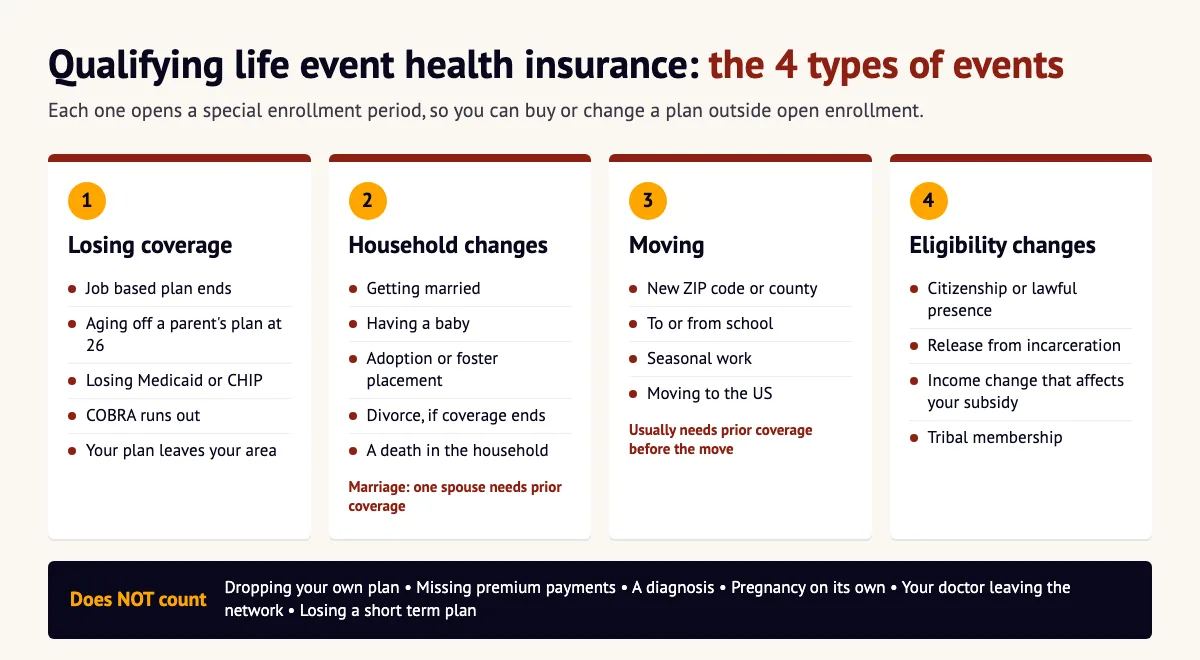
The recognized events fall into four families. HealthCare.gov groups them the same way.
| Family | Events in it |
| Losing coverage | Job based plan ends, aging off a parent’s plan at 26, losing Medicaid or CHIP, losing coverage through divorce or a death, an individual plan ending or leaving your area |
| Household changes | Marriage, birth, adoption, foster placement, divorce or separation with loss of coverage, a death in the household |
| Moving | New ZIP code or county, moving to or from school or seasonal work, moving to the US, leaving a shelter or transitional housing |
| Eligibility changes | Gaining citizenship or lawful presence, release from incarceration, an income change that changes your subsidy, joining a federally recognized tribe |
That table is the whole qualifying life event health insurance list. Next, the sections below explain what each one really means.
How Does Losing Health Coverage Qualify You?
Losing coverage is the most common qualifying event. In particular, the key word is losing, meaning it was taken away rather than dropped by choice.
Leaving or losing a job with benefits. It qualifies whether you quit, were laid off or retired. However, what triggers it is the plan ending, not the job ending.
Aging off a parent’s plan. Children can stay on a parent’s plan until 26. When that coverage stops, you qualify.
Losing Medicaid or CHIP. This counts when the state ends your eligibility, often after an income change or an annual renewal.
Your individual plan going away. If your carrier leaves your county or discontinues your plan, you qualify to pick a new one.
Running out of COBRA. When COBRA reaches its natural end, you qualify. In contrast, if you simply stop paying COBRA early, you do not.
What sits outside this family:
- Cancelling your own plan because you wanted something cheaper.
- Being cancelled for not paying premiums.
- Losing a short term plan. It is not considered real coverage, so losing it does not count. Our guide to temporary health insurance in Texas explains why.
What it should change about your choice: if you are leaving an employer plan, first look at what you actually used it for. A family that saw specialists across Dallas and Fort Worth often needs a broad PPO network, which is more common off the Marketplace than on it.
Which Household Changes Count?
A household change qualifies because it changes who needs coverage, or who can cover whom.
Marriage. Getting married lets either spouse enroll or join the other’s plan. However, there is one condition many people miss: at least one of you generally must have had qualifying health coverage for at least one day in the 60 days before the wedding. Someone uninsured all year cannot marry their way into a plan.
Having a baby. Birth qualifies the whole household, not only the child. Parents can enroll, switch plans, or add the baby to an existing one.
Adoption and foster placement. These work the same way as a birth. Placement of a child, even before the adoption is final, counts.
Divorce or legal separation. Divorce counts only when it causes someone to lose coverage. If you were on your spouse’s plan and that ends, you qualify. On the other hand, if you each had your own plans, nothing changes.
A death in the household. If the person whose plan covered you dies, you qualify for your own coverage.
Is pregnancy a qualifying life event? Not under the federal qualifying life event health insurance rules that Texas follows. The birth qualifies, the pregnancy does not. If you are pregnant and uninsured, Medicaid for pregnant women or CHIP Perinatal may be available year round, depending on income.
What it should change about your choice: a new baby means pediatric visits, vaccines and possibly a NICU network. Check that your preferred hospital and pediatrician are in network before you choose, not after the first bill.
When Does Moving Count as a Qualifying Event?
Moving counts when it gives you access to different health plans. In practice, that means a new ZIP code or county.
Moving within Texas. Houston to Austin qualifies. So does a move from one county to the next if the plan options change. Meanwhile, moving across the street almost never does.
Moving for school or seasonal work. Students moving to or from campus qualify, as do seasonal workers moving to or from where they work.
Moving from another country or a US territory. This counts, and it is the main exception to the condition below.
The condition: you generally need to have had qualifying coverage for at least one day in the 60 days before the move. This is because the rule exists to stop people moving purely to get insured after getting sick.
Do temporary stays count? No. A vacation, a hospital stay, or a few months at a relative’s home is not a permanent move.
What it should change about your choice: networks are local. For example, a plan that worked in San Antonio may have very few doctors in Plano, so a move is the best moment to check the new area’s network rather than keep the old carrier out of habit.
What Counts as a Change in Eligibility?
These events change whether you can buy a plan or get help paying for it.
Gaining citizenship or lawful presence. Becoming eligible to buy through the Marketplace qualifies you to enroll.
Release from incarceration. Leaving jail or prison qualifies you to enroll. Probation or parole does not stop you.
An income change that affects your subsidy. If you are already enrolled and your income shifts enough to make you newly eligible, or no longer eligible, for premium tax credits, you may be able to change plans.
Membership in a federally recognized tribe. Members of federally recognized tribes and Alaska Native shareholders can enroll or change plans once a month, all year.
What it should change about your choice: a lower income can mean a larger tax credit, which can make a richer plan affordable. Conversely, a higher income can mean losing the credit, which is often when private, off-Marketplace coverage with a PPO network becomes the better value.
Does Starting a New Job Count as a Qualifying Life Event?
Starting a new job is not a qualifying event by itself. The coverage changes around it usually are.
- Leaving a job with benefits: qualifies, because you lost coverage.
- A new job that offers a health plan: lets you enroll in that employer plan under its own rules.
- A new job with no benefits, while already uninsured: does not qualify.
- A new employer offering an ICHRA or QSEHRA, where the company gives you money to buy your own plan: this qualifies you to buy an individual plan.
Importantly, one detail matters more than people expect. Employer plans have their own clock. Under federal rules for job based coverage, you typically get 30 days after a life event to change your employer plan, not 60. Ask HR as soon as anything changes.
For the full picture when you are between roles, see health insurance between jobs in Texas.
Is Turning 26 a Qualifying Life Event?
Yes. Coming off a parent’s plan at 26 is a qualifying event, and it is the only one you can see coming years ahead.
That changes how to approach it. Since the date is known, you can compare replacements before the birthday and start the new plan the day the old one ends, with no gap.
Your options usually include a plan through your own job, a Marketplace plan with a possible tax credit, or a private plan bought through a broker.
One honest note: staying on the parent’s plan until it actually ends is normally the cheapest choice. There is rarely a reason to leave early. Our guide to turning 26 in Texas covers each option.
What Does Not Count as a Qualifying Life Event?
This list matters as much as the first one, because these are the situations people most often assume will work.
- Voluntarily dropping coverage, including quitting COBRA early.
- Losing coverage for nonpayment.
- Getting a diagnosis or needing surgery. A health event is not a life event.
- Pregnancy on its own. The birth qualifies, the pregnancy does not.
- Your doctor leaving your plan’s network.
- Your premium going up at renewal. You can switch at open enrollment, not mid year.
- Losing a short term or fixed indemnity plan.
- Changing your mind about a plan you already picked.
Are there exceptions? A few. HealthCare.gov lists exceptional circumstances, such as a FEMA declared disaster, domestic abuse or spousal abandonment, or a Marketplace or insurer error that kept you from enrolling. These are reviewed case by case, and you must explain what happened.
Do These Rules Apply to Private Plans Off the Marketplace?
Yes. Every ACA compliant major medical plan follows the same rules, whether you buy it on HealthCare.gov or directly from a carrier through a licensed broker.
This is the part most guides leave out. Specifically, a qualifying event does not limit you to the Marketplace.
| On the Marketplace | Off the Marketplace (private) | |
| Needs a qualifying event outside open enrollment | Yes | Yes |
| Covers pre-existing conditions | Yes | Yes |
| Premium tax credit available | Yes, if you qualify | No |
| Typical networks in Texas | Mostly HMO and EPO | More PPO options in many counties |
| Who it often suits | Households that qualify for a credit | Households that do not, or need a wider network |
Plans that are not major medical, such as short term and fixed indemnity, do not need a qualifying event at all. They can start almost any month.
However, the trade-off is real. They can exclude pre-existing conditions and may have no out of pocket maximum. They fill a gap; they do not replace comprehensive coverage.
How Do You Prove a Qualifying Life Event?
You show a document that confirms what happened and when, such as an employer letter showing your coverage end date, a marriage certificate, a lease, or a birth certificate.

The Marketplace tells you in your eligibility notice whether proof is needed. The step by step process, and the documents each event usually needs, are on our special enrollment period guide.
Overall, the practical rule is to gather the paperwork before you apply, not after. Applications fail on proof far more often than on eligibility.
Does Buying After a Qualifying Event Cost More?
No. Under qualifying life event health insurance rules, a plan bought after a qualifying event costs the same as the same plan bought during open enrollment. There is no surcharge and no health questions on ACA compliant plans.
Even so, two things can still differ:
- Your deductible may start over if you switch plans mid year, because progress usually does not carry to a new plan.
- Your subsidy may change if the event changed your income. A job loss often increases the credit.
How Do You Choose a Plan After a Qualifying Life Event?
The event tells you that you can enroll. However, it does not tell you which plan to choose, and that choice is usually made in a hurry.
A simple order that works:
- Doctors first. List the doctors and hospitals you want, and check them in each plan’s provider directory.
- Prescriptions second. Look up each medicine in the plan’s drug list.
- Plan type third. An HMO needs referrals and stays in network. A PPO lets you see specialists and go out of network at a higher cost. EPO and POS plans sit in between.
- Total yearly cost last. Premium plus the deductible and out of pocket maximum you would realistically hit, not the premium alone.
In addition, if you are healthy and want to save for future costs, an HSA-qualified high deductible plan is worth a look. It can be paired with a tax free health savings account.
A licensed broker can run this comparison across carriers with you.
Can a Broker Help With a Qualifying Life Event?
A broker can help with qualifying life event health insurance in two ways: confirming your event really qualifies, and comparing plans across carriers once it does. Our service costs you nothing, because carriers pay the broker.
The honest limitation, stated plainly: the qualifying event list is federal and fixed. No broker, navigator or carrier can add to it, and nobody can create eligibility that is not there. If no event applies, the honest answer is that none applies, and the next step is open enrollment or a plan type that does not depend on it.
Closing thoughts
In summary, a qualifying life event is your way into health insurance outside open enrollment, but only if your situation fits the rules behind it.
- Four families: losing coverage, household changes, moving, and eligibility changes.
- Conditions matter: marriage and moving generally require prior coverage.
- Some common situations never count: dropping a plan, a diagnosis, pregnancy alone, or a doctor leaving the network.
- The same rules apply off the Marketplace, where more PPO options sit.
- Choose by doctors and prescriptions first, premium last.
Not sure your situation counts? A licensed Texas broker can check it at no cost before you rely on it. Call Custom Health Plans at (469) 361-4032 or request a free quote.