
Quick answer: When does health insurance open enrollment start? It starts November 1 and runs to January 15 for plans you buy yourself. Enroll by December 15 if you want coverage from January 1. Those are the only dates on this page you need to write down.
Knowing the date is the easy part. Almost everyone who gets open enrollment wrong knew the date perfectly well.
What costs them is not knowing what the window is for: what you are allowed to change, what happens if you do nothing, and why the deadline cannot be moved for you.
If you buy your own plan in Texas, that is what the rest of this page is for.
What Is Open Enrollment, Exactly?
Open enrollment is the one stretch of the year when you can buy or change an individual health plan without having to explain yourself.
No health questions. No proof of a life event. No underwriting. You qualify simply because the window is open.
That is genuinely unusual. For most of the year the individual market is closed to new customers, and this is the exception written into the law.
Three things are true only inside the window:
- Guaranteed acceptance. An insurer cannot refuse you, and cannot charge you more, because of a health condition.
- Free movement. You can leave one carrier for another with no penalty and no waiting period.
- A fresh subsidy decision. Your eligibility for a premium tax credit is assessed for the year ahead.
Outside the window, all three of those disappear. That is the whole reason it matters.
Why Does Health Insurance Have an Open Enrollment Period at All?
Because without one, most people would wait until they were sick to buy insurance, and the system would collapse.
This is worth understanding properly, because it explains almost every rule that follows.
Insurance works by pooling. Healthy people who pay in and claim little make it possible to cover people who need expensive care. The premiums only add up if both groups are in the pool at the same time.
Now imagine you could buy a plan any day of the year, and insurers still had to accept you regardless of your health. The rational move would be to stay uninsured while you feel fine, then sign up in the ambulance.
If enough people did that, the pool would hold only sick people. Premiums would rise, more healthy people would drop out, and premiums would rise again. Economists call that a death spiral, and it is not a hypothetical.
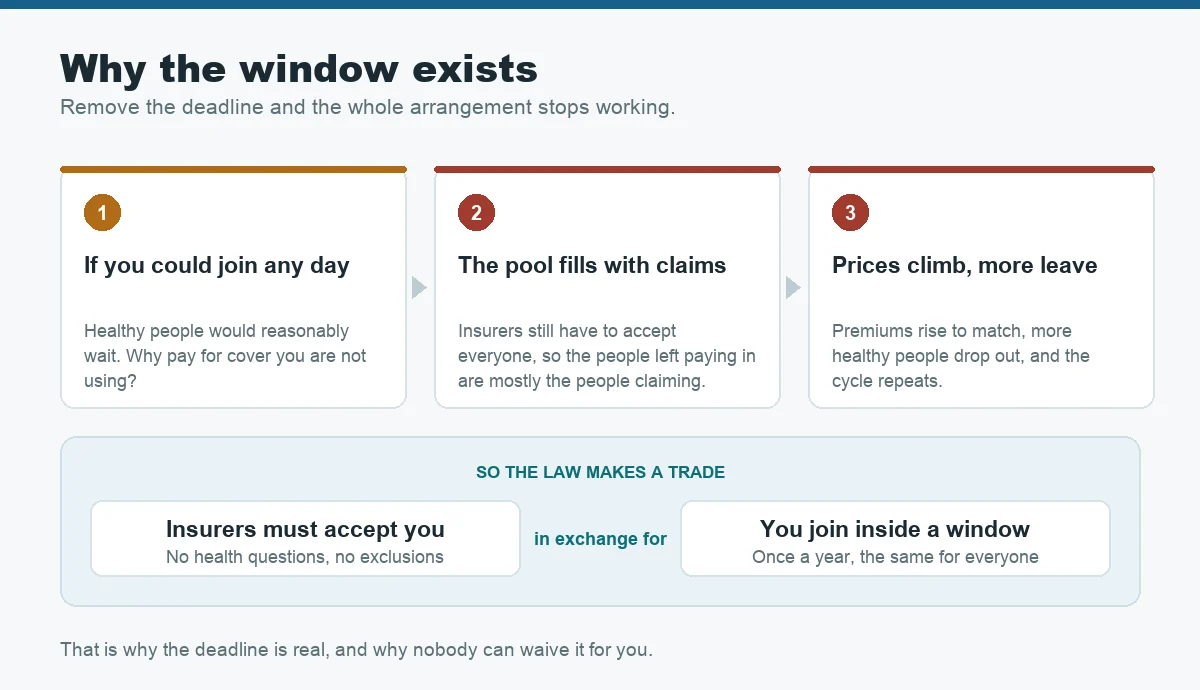
So the law makes a trade. Insurers must accept everyone, with no health questions, and in exchange you can only join during a set window each year.
The practical consequence: the deadline is not administrative box ticking. It is the thing that makes guaranteed acceptance possible in the first place, which is why nobody can waive it for you.
What Can You Actually Do While the Window Is Open?
More than most people realise. Enrolling for the first time is only one of the options.
While open enrollment is running you can:
- Start a plan if you have no coverage at all.
- Switch carriers entirely, for any reason or none.
- Move up or down a metal tier to trade premium against deductible.
- Add or remove people on the policy.
- Apply for a premium tax credit, or have an existing one recalculated.
- Drop coverage you no longer want.
One rule surprises almost everyone: you can change your mind as many times as you like before the deadline. Only the last plan you select counts.
That means there is no penalty for choosing early. Pick something so you are covered, keep looking, and switch if you find better.
Which Types of Coverage Use Open Enrollment, and Which Don’t?
Not all health coverage works this way, and assuming yours does is a common and expensive mistake.
| How you get coverage | Does open enrollment apply? | What that means for you |
|---|---|---|
| You buy it yourself | Yes | The November to January window is your only routine chance |
| Through your employer | Yes, but their window | Your company sets its own dates, usually in the fall |
| Medicare | Yes, its own window | Runs October 15 to December 7 each year |
| Medicaid and CHIP | No | Apply any month, if you qualify |
| Short term plans | No | Sold year round, and not ACA coverage |
| Dental and vision | Usually not | Often available any time, sold separately |
Two of those rows catch people out.
Medicaid and CHIP have no window. If your income drops in April, you do not wait until November. Eligibility is assessed when you apply, and Texas assesses it strictly.
Employer windows are short. Two to four weeks is normal, against about three months on the individual market. Miss it and your current elections usually roll over untouched for another year.
If you are moving between jobs while all this is happening, health insurance between jobs in Texas covers how the gap works.
When Does Health Insurance Open Enrollment Start and End?
The window runs from November 1 to January 15 for anyone buying their own plan, and Texas uses the federal Marketplace, so those are the Texas dates.
Inside it, one earlier date does real work.
| The date | What it does |
|---|---|
| November 1 | The window opens and next year’s plans and prices appear |
| December 15 | Enroll by this date for coverage starting January 1 |
| January 15 | The window closes |
December 15 is the one people miss, because it is not the end of anything. It is the cutoff for a January start. Enroll after it and your coverage begins a month later.
That end date is also worth verifying on anything you read, because it was moved twice in about a year before landing back on January 15, per healthinsurance.org. Older pages still print the wrong one, and the 2027 dates set out the sequence if you want it.
Why Doesn’t Coverage Start the Day You Enroll?
Because health plans run on calendar months, not on the day you sign.
Every individual plan begins on the first of a month. There is no such thing as a plan that starts on the 22nd, which is why enrolling early does not get you covered early.
Two things have to happen before coverage is real. You complete the enrollment, and you pay the first premium. A plan that is selected but unpaid is not active, and this is where a surprising number of people come unstuck.
So the useful question is not how fast you can enroll. It is which month you are buying, and whether you have paid for it.
The honest limitation: signing up on the first morning of the window and signing up in mid December get you exactly the same start date. What early enrollment buys is thinking time, not earlier cover.
What Happens If You Do Nothing?
If you already have a Marketplace plan, you are usually renewed automatically into the same plan, or the nearest one your carrier still sells. You stay insured without doing anything.
That safety net is real, and for plenty of people doing nothing is the right answer.
It is also where people get quietly repriced. Three things can move while you sit still: your premium, your subsidy, which is recalculated from whatever income is on file, and the plan itself if your carrier discontinues it.
Your carrier explains all of this in the notice it mails in the fall. It arrives with everything else and it goes unread, which is a shame, because it is the one document that tells you whether doing nothing is safe this year. We go through what it contains in the 2026 and 2027 guide.
If you have no coverage at all and you do nothing, the outcome is simpler and worse. You are uninsured for the year ahead unless something in your life changes enough to reopen the door.
Is It Cheaper to Buy During Open Enrollment?
No, and this is a common misunderstanding worth clearing up.
Prices are not discounted because the window is open. Premiums are set by your age, your county, the plan you choose and the subsidy you qualify for. The calendar does not move any of them.
What open enrollment actually gives you is choice, which is a different kind of saving. It is the one time you can see every plan available to you and move freely between them.
The saving comes from comparing properly, not from timing. A plan that looked cheapest last year can quietly become the expensive option once the deductible and the network are taken into account.
Is There a Grace Period After Open Enrollment Ends?
No. There is no late window, no short extension, and no version of this where a phone call gets you in after the fact.
Federal deadlines are fixed, and no broker, navigator or carrier can move one. Anyone suggesting otherwise is worth walking away from.
There are two narrow exceptions and neither is something you can plan around. A federally declared disaster can open a special window for an affected region, and a documented technical failure during an application can be reviewed after the fact.
Both are remedies granted afterwards, not options you get to choose.
How Do You Get Covered Outside the Window?
There are three real routes, and they suit very different situations.
A qualifying life event. Losing coverage, moving, marriage, divorce, a new baby, or turning 26 opens a special enrollment period of 60 days, according to HealthCare.gov. This gets you a full ACA plan on the same terms as open enrollment. If you are unsure which situation you are in, open enrollment versus special enrollment sets the two side by side.
Medicaid or CHIP. No window and no life event needed, only eligibility.
Coverage that sits outside the ACA rules. Short term health insurance and similar products can be bought any month.
Be clear about the trade on that last one. Short term plans are not ACA compliant major medical. They can ask about your health history, exclude pre-existing conditions, and carry no cap on what you pay out of pocket.
They are a bridge, not a substitute. Missed open enrollment in Texas covers what is left when none of the three apply.
What Should You Actually Do With the Window?
Work in this order: your doctors, your prescriptions, your likely cost for the whole year, and the monthly premium last.
Premium last is deliberate, and it is the part people get backwards. The cheapest monthly figure is often not the cheapest year once the deductible is counted.
- Check your doctors against the plan’s network, on the carrier’s own directory rather than a comparison tool.
- Check your prescriptions on the formulary, and note which tier each one sits on.
- Add up a realistic year, premiums plus the deductible you would actually reach, capped by the out of pocket maximum.
- Decide between plan types. An HMO usually costs less and asks you to stay inside a network. A PPO costs more and is easier to travel with.
- Then look at the premium, knowing what it buys.
One honest note: all of this is something you can do yourself. It takes about an evening per plan you are seriously considering. What a broker saves you is the evenings, not the ability.
For the wider picture, including subsidies and plan types, our complete guide to health insurance open enrollment covers the ground this page does not.
Why Does This Matter More in Texas?
Texas has the highest uninsured rate in the country, and has not expanded Medicaid.
The effect is that a large group of working Texans earn too much to qualify for Medicaid and are offered nothing at work. For them the individual market is not one option among several. It is the only route to comprehensive coverage.
That is why a missed window costs more here. In a state with expanded Medicaid there is often a second door. In Texas, frequently, there is not.
If you want a second pair of eyes on your options, comparing individual plans in Texas is where to start.
Conclusion
Open enrollment starts November 1 and closes January 15, but the dates are the least interesting part of it.
- It exists to make guaranteed acceptance possible. That is why the deadline is real and why nobody can waive it.
- It is the only time you can move freely between carriers and plans without explaining yourself.
- Doing nothing renews you, on terms that may have changed while you were not looking.
- Enrolling early does not start coverage early. It buys you time to choose well.
- Missing it is not the end, but every remaining route has a condition attached.
If you would like someone to talk through which plans in your county actually fit your doctors and prescriptions, Custom Health Plans is a Texas brokerage and the conversation costs nothing. Call (469) 361-4032 or request a quote.