
Wondering how to get health insurance outside of open enrollment? You have more options than most people expect. Each one, however, works differently and protects you differently.
Most guides hand you a list of dates. Instead, this guide explains how each route actually works, so you can choose the one that fits your health, your budget and your timing.
It also covers what to do if open enrollment has already closed.
Key takeaways:
- A qualifying life event opens a 60 day window to buy full major medical coverage.
- Medicaid and CHIP accept applications all year if you qualify.
- Short term, fixed indemnity and underwritten association plans can start almost any month, with real trade-offs.
- Private major medical bought from a carrier follows the same calendar as the Marketplace.
- The right route depends on your health, your doctors and how long the gap is.
Why Can You Only Get Health Insurance During Open Enrollment?
Major medical plans must accept everyone and cannot charge more for a health condition. That protection is the reason the calendar exists.
If anyone could join the day after a diagnosis, many people would wait until they were sick to buy coverage. Premiums would then climb for everyone who stayed insured.
So the market opens to everyone once a year. Outside that window, it opens only for people whose lives genuinely changed.
This one idea explains every rule that follows. Coverage that asks no health questions comes with a calendar. Coverage that skips the calendar usually asks health questions.
Can You Get Health Insurance If It Is Not Open Enrollment?
Yes. The answer to how to get health insurance outside of open enrollment is one of four routes. Which one is open to you depends on your situation, not on the date.
| Route | Who it is for | What you get | When it can start |
| Special enrollment period | Anyone with a qualifying life event in the last 60 days | Full major medical, pre-existing conditions covered | Usually the 1st of the next month |
| Medicaid or CHIP | Texans who meet the income and eligibility rules | Low or no cost comprehensive coverage | Any month |
| A job that offers benefits | New hires, under the employer’s own rules | Group health coverage | After any waiting period |
| Year-round private plans | Anyone, any month | Short term, fixed indemnity or underwritten association coverage | Often within days |
The first three give you comprehensive coverage. The fourth fills a gap, so it is worth knowing exactly what it does before you rely on it.
How to Get Health Insurance Outside of Open Enrollment With a Qualifying Life Event
A qualifying life event is a change the federal rules accept as a fair reason to enroll mid year. It opens a special enrollment period, usually 60 days long.
The events fall into four groups:
- Losing coverage, such as a job based plan ending, turning 26, or losing Medicaid.
- Household changes, such as marriage, a birth or an adoption.
- Moving to a new ZIP code or county with different plans.
- Eligibility changes, such as gaining lawful presence in the US.
Our full list of qualifying life events explains the fine print behind each one.
Three details decide whether this route works for you.
The clock starts on the event date. It does not start the day you noticed, or the day the letter arrived.
You can often act before a loss. If you know your coverage is ending, you can usually apply up to 60 days ahead, so the new plan starts the day the old one stops.
Proof is part of the process. After you pick a plan, you may be asked for documents that confirm the event, typically within 30 days. Gather them before you apply.
Coverage bought this way is full major medical. It covers pre-existing conditions, has an out of pocket maximum, and costs the same as it would during open enrollment.
Lost a job based plan? COBRA lets you keep it, usually at the full cost. Job loss also opens a special enrollment period, so compare both before you elect. Our COBRA alternatives guide breaks down the trade-off.
What Plans Can You Buy Any Month of the Year?
For many people without a qualifying event, the practical answer to how to get health insurance outside of open enrollment is a plan that ignores the calendar.
The trade-off is that most of these plans can look at your health history before they accept you.
Short term health insurance. A temporary medical plan built to bridge a gap. It often starts within days.
In Texas, short term plans can now run up to three years including renewals. They can, however, decline applicants and exclude pre-existing conditions. Our short term health insurance in Texas guide covers how they work.
Fixed indemnity plans. These pay a set cash amount for a covered event, such as a fixed sum per hospital day or doctor visit. The payment stays the same whatever the bill is. See our fixed indemnity health insurance page.
Association health plans. Coverage you reach through membership in an association, often with broad PPO networks. Many are fully underwritten, meaning the carrier reviews your health before approving you. Learn more about association health plans.
Health care sharing ministries. Members share each other’s medical bills under faith based guidelines. They are not insurance, so sharing is not guaranteed the way a claim is.
What most year-round plans have in common:
- They are not major medical, so they can exclude a condition you already have.
- Many have no out of pocket maximum, so a serious claim has no ceiling.
- They can skip benefits major medical must include, such as maternity or mental health care.
For a healthy person bridging a few months, that trade can be reasonable. For someone managing a condition, it often is not.
Can You Get Private Health Insurance Outside of Open Enrollment?
It depends on which kind of private plan you mean. Many people researching how to get health insurance outside of open enrollment assume private means any time. It does not.
A private major medical plan bought directly from a carrier, off the Marketplace, follows the same calendar as a Marketplace plan. Outside open enrollment, you still need a qualifying life event.
The private plans you can buy any month are the underwritten kinds described above: short term, fixed indemnity and many association plans.
The upside of private major medical is choice. In many Texas counties, more PPO options sit off the Marketplace, which matters if you want to keep specific doctors. Our Texas individual health insurance page compares them.
How Do You Decide Which Route Is Right for You?
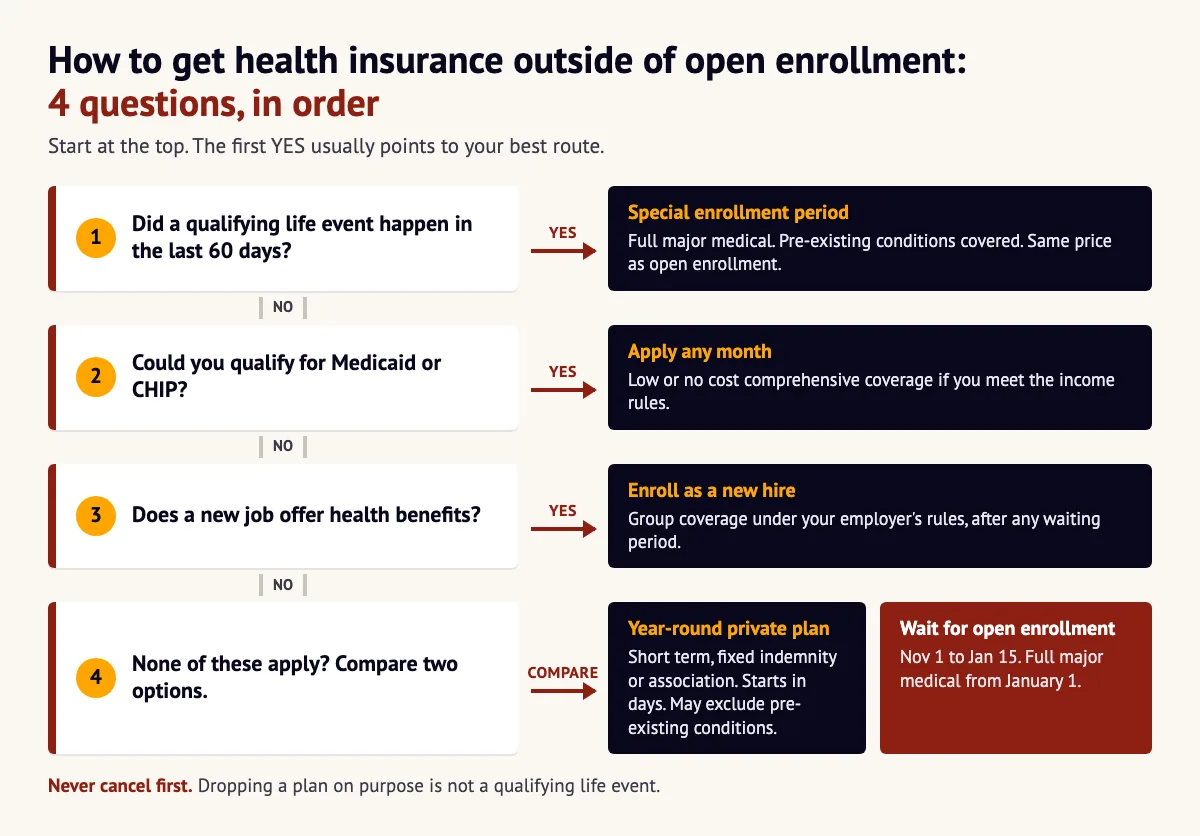
Work through four questions in order. The first one that applies to you usually points to the best route.
- Did a qualifying life event happen in the last 60 days? Use it. It gets you full coverage at the normal price.
- Could you qualify for Medicaid or CHIP? Check before you buy anything. You can apply any month.
- Does a new job offer benefits? Enroll as a new hire under your employer’s rules.
- None of these apply? Compare a year-round private plan against waiting for open enrollment.
That order is the simplest answer to how to get health insurance outside of open enrollment without overpaying or underinsuring.
Should You Buy Now or Wait for Open Enrollment?
If no qualifying event applies, this is the real decision. It comes down to your health, your doctors and how long you would be uninsured.
The next open enrollment runs November 1, 2026 to January 15, 2027. Pick a plan by December 15 and coverage starts January 1.
| Your situation | What usually makes sense |
| Healthy, gap of a few weeks | Many people wait. Some buy a short term plan for peace of mind. |
| Healthy, gap of several months | Price a short term or underwritten plan seriously |
| Ongoing condition or regular prescriptions | Look hard for a qualifying event. Year-round plans may exclude the condition. |
| Expecting a baby | Check Medicaid for pregnant women. Many year-round plans exclude maternity. |
| Low household income | Check Medicaid and CHIP first |

Before you decide, ask yourself three questions:
- What would one hospital stay cost you uninsured? If it would wipe out your savings, a gap plan is protection, not an expense.
- Will the plan cover what you already need? Read the exclusions for any condition or medicine you use today.
- Can you keep your doctors? Check the network before you buy, not after the first bill.
Can You Still Get Health Insurance After Open Enrollment Ends?
Yes. Missing the deadline closes only one route. How to get health insurance outside of open enrollment works the same way after it closes: the special enrollment, Medicaid, employer and year-round routes all stay open.
What changes is timing. Without a qualifying event, full major medical coverage generally has to wait for the next open enrollment window.
Is there a grace period after open enrollment? Not for signing up. The grace period people hear about applies to paying a late premium on a plan you already have, not to enrolling late.
Our guide to missing open enrollment in Texas walks through the months between windows.
Can You Get Around Open Enrollment?
Not for major medical, unless one of the routes above applies. There is no legitimate shortcut, and a few common workarounds backfire.
- Cancelling a plan to trigger a new window. Dropping coverage on purpose is not a qualifying event.
- Reporting an event that did not happen. Events can require proof, and misstating facts on an application can get coverage cancelled.
- Moving on paper only. A move must be permanent, and usually requires prior coverage.
What does work is legitimate: a real life change, a year-round plan for the gap, or exceptional circumstances such as a declared disaster, which are reviewed case by case.
Is Healthcare Cheaper Without Insurance?
For routine care, sometimes. A cash price for a basic visit or a generic prescription can cost less than a premium plus copays.
For anything serious, almost never. Insured patients pay the carrier’s negotiated rates, while uninsured patients are often billed the full list price.
One emergency room visit or a short hospital stay can cost thousands of dollars. Insurance exists for the bill you cannot predict, not the one you can.
Can You Switch Health Insurance Outside of Open Enrollment?
Only with a qualifying life event. Finding a cheaper plan, disliking your network or regretting your choice does not qualify on its own.
If you do have an event, think about your deductible first. Progress toward it usually resets to zero on a new plan, so a mid year switch can cost more than it saves.
Can You Cancel Health Insurance Outside of Open Enrollment?
You can usually cancel an individual plan at any time. The catch is that cancelling does not let you buy a new major medical plan.
Cancel with no qualifying event and you may be uninsured until the next open enrollment. Line up the replacement first, and cancel second.
Employer plans work differently. Mid year changes to payroll deducted coverage generally need a qualifying event, so check with HR before you act.
Can You Remove Someone From Your Health Insurance Outside of Open Enrollment?
On an individual plan, you can generally remove a family member at any time by updating your application or calling your carrier.
On an employer plan, removing a dependent mid year usually needs a qualifying event, such as a divorce or the dependent gaining their own coverage.
Before you remove anyone, make sure they have coverage to move to. Removing a person also changes your premium, because premiums are set by who is on the plan.
How Can a Broker Help You Get Coverage Outside Open Enrollment?
A licensed broker can show you how to get health insurance outside of open enrollment for your exact situation. That starts with checking whether you qualify for a special enrollment period, then comparing plans from top carriers side by side.
If no event applies, a broker can set the year-round options next to the cost of waiting, so you can see both clearly. The help costs you nothing, because carriers pay the broker.
The honest limitation: no broker can create a qualifying event that is not there. If none applies, the honest answer is a year-round plan or the next open enrollment.
Closing thoughts
Learning how to get health insurance outside of open enrollment starts with one question: did your life change in the last 60 days?
- A qualifying life event gives you 60 days to buy full coverage at the normal price.
- Medicaid and CHIP accept applications all year.
- Year-round private plans fill gaps, with real limits on pre-existing conditions.
- Private major medical follows the same calendar as the Marketplace.
- Never cancel first. Line up the replacement before you drop a plan.
Not sure which route fits you? Custom Health Plans is a licensed Texas brokerage, and one short call can sort it out. Call (469) 361-4032 or request a free quote.