
What is out of pocket maximum? It is the most you pay for covered, in-network care in one plan year. Your deductible, copays and coinsurance all add up toward it. Once you reach it, your plan pays 100% of covered in-network care for the rest of that year. Premiums do not count.
The deductible gets most of the attention, but the out-of-pocket maximum is the number that protects you in a bad year. It is your ceiling, the most a covered illness or injury can cost you before the plan takes over.
This guide shows what counts toward it, what never does, the 2026 and 2027 limits, and real bill math for a hospital stay, a baby and a family.
Four things to know about any out-of-pocket maximum:
- It is a yearly ceiling. It covers your share of covered, in-network care and resets each plan year.
- Three costs fill it. Deductible, copays and coinsurance all count.
- Premiums never count. You keep paying them after you reach the cap.
- Not every plan has one. ACA-compliant plans must. Many short-term plans do not.
What Is Out of Pocket Maximum, and How Does It Work?
An out-of-pocket maximum is a cap on your share of covered medical bills in one plan year. You share costs until your running total hits the cap, and then the plan pays the rest of your covered in-network care.
Think of it as a finish line. Every dollar you pay toward covered, in-network care moves you closer, no matter which kind of cost it is.
Here is the order on a typical plan:
- You pay your premium. This keeps the plan active. It never moves you toward the cap.
- You pay toward your deductible. You pay the plan’s negotiated price, called the allowed amount, until you meet the deductible.
- You share each bill. After the deductible, you pay coinsurance, such as 20%, or a flat copay. The plan pays the rest.
- You reach the out-of-pocket maximum. Your deductible, copays and coinsurance together hit the cap.
- The plan pays 100%. Covered in-network care costs you nothing more until the plan year resets.
The out-of-pocket maximum is one of four numbers that decide what a plan really costs. Our guide on how health insurance works shows how the premium, deductible, cost sharing and network fit together.
What Counts Toward Your Out-of-Pocket Maximum, and What Does Not?
Your share of covered, in-network care counts. Premiums, out-of-network care, services your plan does not cover and charges above the allowed amount do not.
| What you pay | Counts toward the out-of-pocket maximum? |
| Deductible payments for covered in-network care | Yes |
| Coinsurance for covered in-network care | Yes |
| Copays for covered in-network care | Yes, on ACA-compliant plans |
| Covered prescriptions filled in network | Yes, on ACA-compliant plans |
| Monthly premiums | No |
| Out-of-network care | Usually no, many plans have a separate limit |
| Services your plan does not cover | No |
| Charges above the allowed amount (balance bills) | No |
A few of these trip people up.
Premiums are the price of keeping the plan. You owe them every month whether you see a doctor or not, so they sit outside the cap.
Balance bills happen when an out-of-network provider charges more than your plan’s allowed amount and bills you for the difference. That gap never counts.
The No Surprises Act now protects you from many surprise bills, such as most emergency care. CMS explains that for protected care, what you pay counts toward your in-network deductible and out-of-pocket limit.
Does the Deductible Count Toward the Out-of-Pocket Maximum?
Yes, on most plans. Your deductible is the first part of your out-of-pocket maximum, not a separate bill on top of it.
Say your plan has a $3,000 deductible and a $7,500 out-of-pocket maximum. Once you pay the $3,000 deductible, you have $4,500 left to reach the cap, paid through coinsurance and copays.
This is why the deductible is always the smaller number. For a bill-by-bill look at how the first part works, see our health insurance deductible explained guide.
Do Copays and Prescriptions Count Toward Your Out-of-Pocket Maximum?
On ACA-compliant plans, yes. Copays and coinsurance for covered, in-network care count, and that includes covered prescriptions filled at in-network pharmacies.
Two details can change your number:
- Drugs your plan does not cover do not count. Check the plan’s drug list before you enroll.
- Manufacturer coupons may not count. Some plans use copay accumulator programs, which KFF explains apply the coupon to each fill without counting it toward your deductible or out-of-pocket maximum.
If you take a costly brand-name drug, ask how the plan treats coupons before you pick it.
What Happens If You Meet Your Deductible but Not Your Out-of-Pocket Maximum?
You keep sharing costs. After the deductible, you pay coinsurance or copays on each covered bill until your total reaches the cap or the plan year ends.
That middle stretch is what “after deductible” means on a plan summary. It tells you a service is billed at your coinsurance rate once the deductible is met.
Most years, people land here. They meet the deductible after a few visits or one procedure, pay some coinsurance, and never reach the cap at all.
Does Insurance Pay 100% After You Hit Your Out-of-Pocket Maximum?
Yes, for covered, in-network care. After you reach the cap, you pay nothing more for those services until your plan year resets.
Three things still cost money after you reach it:
- Your monthly premium. It does not stop or drop.
- Services your plan excludes. A non-covered service is billed to you in full.
- Out-of-network care. Unless it is protected emergency care, it often falls under a separate limit or none.
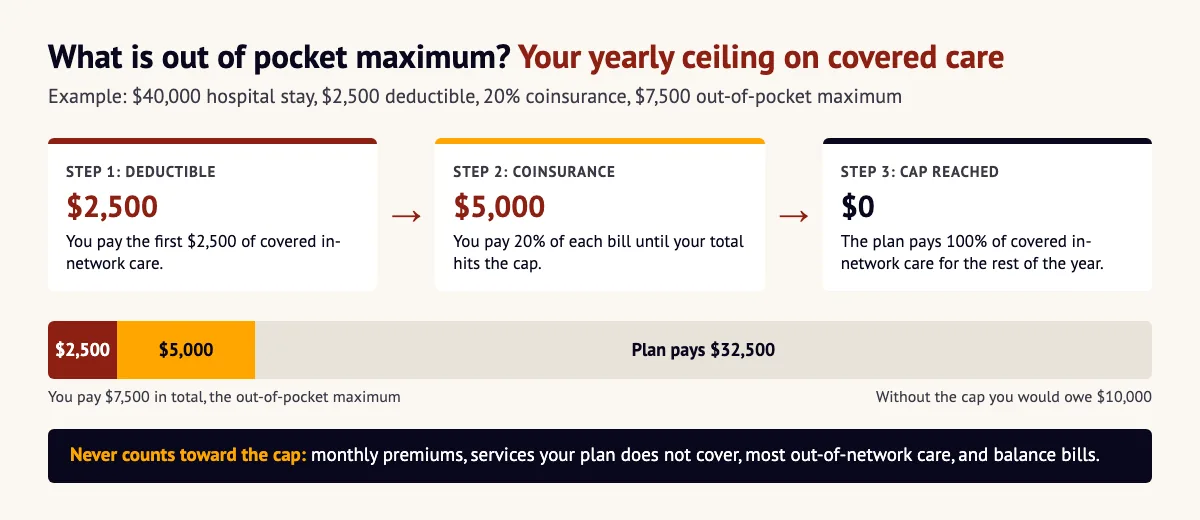
Here is a worked example. Your plan has a $2,500 deductible, 20% coinsurance and a $7,500 out-of-pocket maximum. A hospital stay has an allowed amount of $40,000.
| Step | Math | You pay |
| Deductible | First $2,500 of the bill | $2,500 |
| Coinsurance | 20% of the remaining $37,500 | $7,500 |
| Total before the cap | $2,500 + $7,500 | $10,000 |
| Cap applies | Stops at your out-of-pocket maximum | $7,500 |
Without the cap, you would owe $10,000. With it, you pay $7,500 and the plan pays the other $32,500. Any more covered in-network care that year is fully covered.

What Are the Out-of-Pocket Limits for 2026 and 2027?
For ACA-compliant plans, the 2026 limit is $10,600 for one person and $21,200 for a family. In 2027, it rises to $12,000 and $24,000.
These figures are federal ceilings published on HealthCare.gov. Your plan’s maximum can be lower, but an ACA-compliant plan cannot set it higher. For comparison, the 2025 limit was $9,200 and $18,400.
HSA-qualified high deductible plans have a lower IRS ceiling, set in Rev. Proc. 2025-19 for 2026 and Rev. Proc. 2026-24 for 2027.
| Plan type | 2026 individual | 2026 family | 2027 individual | 2027 family |
| ACA-compliant plan | $10,600 | $21,200 | $12,000 | $24,000 |
| HSA-qualified high deductible plan | $8,500 | $17,000 | $8,700 | $17,400 |
Most real plans sit well below the federal ceiling. Among workers with employer coverage, the KFF 2025 Employer Health Benefits Survey found 12% have a single-coverage limit of $2,000 or less and 21% have one above $6,000.
Our health savings account rules guide explains how HSA-qualified plans pair with a tax-free savings account.
Why Am I Paying More Than My Out-of-Pocket Maximum?
If you paid more than your cap, the extra almost always came from costs the cap does not cover. The usual causes are:
- Out-of-network care. Those bills often sit under a separate, higher limit, or none.
- Non-covered services. You pay in full, and none of it counts.
- Balance bills. The gap between a provider’s charge and the allowed amount never counts.
- Premiums. They are a separate cost.
- A plan change mid-year. A new plan usually starts your deductible and out-of-pocket total over at zero.
- A claim error. Billing and processing mistakes do happen.
If something looks wrong, ask your insurer for the explanation of benefits on each claim. It shows the allowed amount, what the plan paid and what was applied to your cap.
How Does the Out-of-Pocket Maximum Work When You Have a Baby?
Childbirth is one of the most common times people reach their cap. Prenatal care, delivery and the hospital stay can push a full year’s cost sharing into a few months.
Here is an example with simple numbers. Your plan has a $3,000 deductible, 20% coinsurance and a $7,000 out-of-pocket maximum. The allowed amount for delivery and the hospital stay is $25,000.
- You pay the $3,000 deductible.
- 20% of the remaining $22,000 would be $4,400.
- $3,000 + $4,400 = $7,400, which is over the cap.
- You pay $7,000. The plan pays the other $18,000.
Many routine prenatal visits count as preventive care on ACA-compliant plans, so they may cost little or nothing. The newborn’s own care is often billed separately and can apply to the family limit.
Timing matters too. A delivery in November means your total resets in January, while a delivery in February leaves most of the year fully covered.
How Does a Family Out-of-Pocket Maximum Work?
Family plans have two limits: one for each person and one for the whole family. On ACA-compliant plans, no one person pays more than the individual limit, even inside a family plan.
That rule is called an embedded individual limit, and federal rules have required it on ACA-compliant plans since 2016.
Here is an example. A family plan has a $7,000 individual limit and a $14,000 family limit.
| Family member | Covered costs paid | Result |
| Parent A | $7,000 | Reaches the individual cap. The plan pays 100% for Parent A. |
| Parent B | $3,000 | Still sharing costs |
| Child | $4,000 | Still sharing costs |
| Family total | $14,000 | Family cap reached. The plan pays 100% for everyone. |
Parent A stopped at $7,000 before the family reached its total. Once all three reached $14,000 combined, the whole family was covered in full.
Deductibles follow the same two-level pattern. Our post on family deductible vs individual deductible shows how both numbers interact.
Does the Out-of-Pocket Maximum Reset Every Year?
Yes. Your out-of-pocket total goes back to zero when a new plan year starts, along with your deductible.
For most individual plans, the plan year runs January through December. Some employer plans and private plans use a different 12-month cycle, so check the start date on your plan summary.
If you are close to your cap late in the year, it can make sense to schedule covered care before the reset. Talk with your doctor about timing first.
What Is a Good Out-of-Pocket Maximum for Health Insurance?
A good out-of-pocket maximum is one you could actually pay in a bad year. A lower cap gives more protection, but it usually comes with a higher monthly premium.
Use this worst-case test on every plan you compare:
- Multiply the monthly premium by 12.
- Add the out-of-pocket maximum.
- The total is your worst-case yearly cost for covered, in-network care.
Here is how two plans compare:
| Plan A | Plan B | |
| Monthly premium | $380 | $520 |
| Yearly premiums | $4,560 | $6,240 |
| Out-of-pocket maximum | $9,000 | $4,000 |
| Worst-case year | $13,560 | $10,240 |
Plan A costs less in a quiet year. Plan B costs $3,320 less in a bad year. Neither is wrong, so match the plan to how much care you expect and how much cash you could pay on short notice.
Do All Health Plans Have an Out-of-Pocket Maximum?
No. ACA-compliant plans must have one, on or off the Marketplace. Short-term, fixed indemnity and some other non-ACA plans follow different rules.
Federal law does not require short-term plans to cap your costs. In its October 2025 review, KFF found that most short-term plans have no out-of-pocket maximum or apply it only to certain costs.
Where a cap exists, KFF found it can reach $32,500 in most cities studied, about 3.5 times the highest Bronze cap. The same review found short-term plans may also limit total benefits to as little as $100,000 per policy term.
In Texas, short-term plans run from 30 days to 12 months. They can cost less each month, which is why it pays to read the cap, the benefit limit and the exclusions before you rely on one.
How Do PPO and Private Plans Handle the Out-of-Pocket Maximum?
A PPO or private plan bought directly from a carrier works the same way for in-network care. It has a deductible, cost sharing and a cap. What changes is out-of-network care.
PPOs let you see out-of-network providers, usually at a higher share of the cost. Many PPOs set a separate, higher out-of-network maximum, and some have none for out-of-network care.
HMOs and EPOs usually cover out-of-network care only in emergencies, so their in-network cap is the one that matters.
Metal tiers like bronze and silver apply to Marketplace and group plans, not to off-exchange private or association plans. Compare the real dollar caps, not tier names.
For a side-by-side look at plan types, see HSA vs PPO vs HMO.
How Custom Health Plans Helps
Out-of-pocket maximums are easy to misread. Each carrier lists in-network and out-of-network caps in a different place, and the family figures can differ again.
Custom Health Plans is a Texas health insurance broker with more than 30 years in health insurance and financial services. We have helped hundreds of Texas families and earned more than 400 five-star Google reviews.
We compare PPOs and private plans from top carriers side by side, including the premium, deductible, out-of-pocket maximum and network. We show you what each plan would cost in a bad year, not just a good one.
Closing thoughts
What is out of pocket maximum in one line: it is the most you pay for covered, in-network care in a plan year, and after you reach it the plan pays the rest.
- It includes your deductible. Copays and coinsurance fill the rest.
- Premiums never count. Neither do non-covered services or most out-of-network bills.
- ACA-compliant plans have a ceiling. It is $10,600 for one person in 2026 and $12,000 in 2027.
- Short-term plans may have no cap. Read the policy before you rely on one.
- Compare worst-case years. Twelve premiums plus the cap shows what a bad year really costs.
For plans that fit your budget in a good year and a bad one, see our Texas health insurance plans, or call (469) 361-4032 for a free side-by-side comparison.