
Special enrollment period health insurance is coverage you buy outside the yearly open enrollment window because something specific changed in your life. You usually get 60 days from that change to pick a plan, and then about 30 days to prove the change happened.
Most people meet a special enrollment period at a bad moment. A job has ended, a baby has arrived, or the moving boxes are still in the hall.
So this guide does not just list rules. It explains how the window works, why some changes count and others do not, and where applications quietly go wrong.
What Does Special Enrollment Period Mean?
A special enrollment period is a limited window, normally 60 days, when you can enroll in or change a health plan outside the annual open enrollment period, because of a qualifying life event.
HealthCare.gov defines it as a time outside yearly open enrollment when you can sign up for coverage after certain life events.
The idea behind it is simple. Open enrollment happens once a year, and life does not wait for November.
Inside the window you can do what you could do during open enrollment:
- Enroll in a plan if you have none.
- Switch to a different plan or carrier.
- Add or remove people from your coverage.
Outside it, carriers are not required to sell you major medical coverage at all. That is the whole reason special enrollment period health insurance matters.
How Does Special Enrollment Period Health Insurance Work?
Special enrollment period health insurance works on a trade. You get access outside the normal season, and in return you have to show that a real event opened the door.
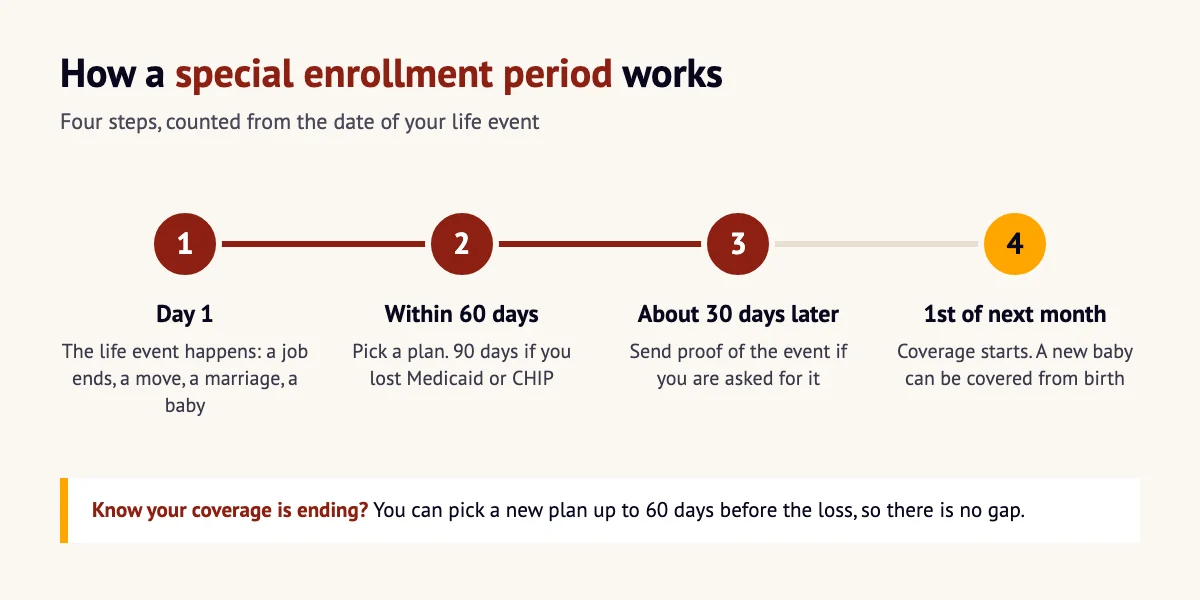
Three things happen in order:
- An event happens. It has to be one of the changes on the federal list, not just a feeling that you need coverage.
- You pick a plan inside the window. For most events that means within 60 days.
- You confirm the event. You are often asked for a document, and the request has its own deadline.
The rules come from the Affordable Care Act, the law behind ACA open enrollment, and they apply to every plan in the individual market that follows it.
That includes plans on the Marketplace and private plans bought directly from a carrier, off the Marketplace. The same event opens both doors. That matters in Texas, because the broader PPO networks tend to sit in private coverage rather than on the exchange.
What Triggers a Special Enrollment Period?
Four kinds of change trigger a special enrollment period: losing coverage, a change in your household, a move, and a change in your eligibility.
The list behind special enrollment period health insurance is federal. It is not a judgment call, and a carrier cannot add to it or take from it.
Losing health coverage
- Losing job based coverage, whether you were let go or you resigned
- Turning 26 and aging off a parent’s plan
- Losing Medicaid or CHIP
- Losing coverage through divorce, legal separation or a death in the household
- COBRA running out at the end of its term
- A plan year ending on a date other than December 31
The coverage you lose has to count as minimum essential coverage. A short term plan ending does not qualify, because it was never major medical in the first place.
Household changes
- Getting married
- Having a baby
- Adopting a child or placing a child in foster care
- A death that changes who is eligible on your plan
Where you live
- Moving to a new ZIP code or county with different plans available
- A student moving to or from where they study
- Moving to the United States from abroad
Eligibility changes
- Gaining U.S. citizenship or lawful presence
- Release from incarceration
- Your job based plan becoming unaffordable, or your employer offering an ICHRA or QSEHRA instead
- An income change that moves you into or out of help with premiums
There are also exceptional circumstances, such as a declared natural disaster, and a monthly enrollment right for American Indians and Alaska Natives.
What Are Three Scenarios That Qualify You for a Special Enrollment Period?
The three most common are losing your job based coverage, having or adopting a baby, and moving to a new county or ZIP code with different plans.
They show the three families of events in one example each. The first is a loss, the second a household change, and the third a move.
If your situation looks like one of those, you very likely qualify. If it only looks a little like one, check it before you rely on it.
What Does Not Count as a Qualifying Life Event?
Some changes feel like they should count and do not. Knowing them in advance saves a denied application.
- Dropping your own coverage because you wanted to, or because the premium felt high.
- Being cancelled for non-payment. This is the one loss of coverage that never qualifies. Our health insurance deadline guide explains why.
- Getting sick or being diagnosed with something new.
- Pregnancy on its own. On HealthCare.gov, the birth is the event, not the pregnancy.
- Deciding you picked the wrong plan in open enrollment.
Does retirement qualify? Retirement by itself does not. Losing the job based coverage that came with your job does. If you are turning 65, Medicare has its own enrollment windows, which work differently.
The exclusions are deliberate. They stop people from buying coverage only once they need care, which would push every premium up.
Why Do Some Events Require Prior Coverage?
For some events, you must already have had coverage for at least one day in the 60 days before the event.
This applies mainly to moving and getting married. It stops someone from moving across a county line purely to open a window.
There are exceptions. People moving from abroad or from a U.S. territory, for example, do not have to show prior coverage. If you are unsure, check before you apply.
It is one of the least known rules, and it explains a lot of confused denials.
How Long Does a Special Enrollment Period Last?
Special enrollment period health insurance windows last 60 days for most events. HealthCare.gov confirms the 60 day window after the qualifying event.
There are two useful variations.
If you know coverage is ending, you can act up to 60 days *before* the loss. A known end date is the best position to be in, because you can line up the new plan with no gap.
If you are losing Medicaid or CHIP, HealthCare.gov now gives you 90 days after the loss to pick a plan, not 60.
| Step | Time you have |
|---|---|
| A known loss of coverage | Up to 60 days before it |
| Most qualifying events | 60 days after the event |
| Losing Medicaid or CHIP | 90 days after the loss |
| Sending proof after picking a plan | About 30 days |
The clock starts on the date of the event, not the day you noticed it. Sixty days disappear fast in the months these events happen.
When Does Your New Coverage Start?
Special enrollment period health insurance usually starts on the first day of the month after you pick a plan. Two situations are different.
- Loss of coverage: if you pick a plan before the old one ends, the new one starts the first of the following month, so there is no gap.
- Birth, adoption or foster care: coverage can start on the day of the event, even if you enroll weeks later.
There are no mid month starts for other events. Choosing a plan on the 3rd or the 28th usually makes no difference to the start date, so picking early mostly buys you time for the document step.
Does Health Insurance End the Day You Quit?
Usually not on that exact day. Most job based plans end either on your last day of work or at the end of that month, depending on the plan.
Your employer or HR team can tell you the exact date, and it is worth asking for in writing. That letter is often the very document you will need later.
Leaving a job counts as losing coverage even if you resigned. The loss is what qualifies, not the reason you left.
Can you keep paying for your work plan after you quit? Usually yes, through COBRA, for up to 18 months. You pay the full premium plus a small fee, which is often a shock after years of employer help.
You can leave COBRA for a new plan within your 60 days. Dropping COBRA later, outside open enrollment, does not open a new window. For cheaper routes, see COBRA alternatives in Texas and health insurance between jobs.
Can I Change Plans During a SEP?
Yes. Special enrollment period health insurance rules let you switch plans or carriers, not just enroll for the first time.
There is one limit worth knowing. If you already have a plan and your event is adding someone, such as a new spouse or baby, you are often limited to plans at the same coverage level you already have.
Switching mid year has a hidden cost too. Your deductible usually restarts on the new plan.
If you have already paid a lot toward this year’s deductible, work that out first. Staying on a more expensive plan is sometimes the cheaper choice for the rest of the year.
How Do You Apply for a Special Enrollment Period?
You apply for special enrollment period health insurance the same way you would in open enrollment, with one extra question about the event and its date.
- Write down the event date. Everything counts from it.
- Gather the proof now, before you apply, not after.
- Choose your route. Apply through HealthCare.gov, or buy a private plan directly from a carrier. A broker can compare both routes side by side at no cost to you.
- Report the event and pick a plan inside the window.
- Pay the first premium. A plan is not active until it is paid.
- Watch for a document request in your account for the next few weeks.
If you receive help with premiums, that help is only available through the Marketplace. Private plans bought off the exchange cost the same with or without it. Which route wins depends on your income and on which doctors you need.
How Do You Prove a Qualifying Life Event?
You prove it with a document showing what happened and when. After you pick a plan, you usually get about 30 days to send it.
This is where special enrollment period health insurance applications most often fail, and the pattern repeats. Someone qualifies, applies on time, picks a plan, feels finished, and never sees the request.
| Event | Document usually accepted |
|---|---|
| Lost job based coverage | Letter from the employer or insurer showing the end date |
| Turning 26 | Proof of prior coverage and date of birth |
| Moved | Lease, mortgage statement or utility bill showing both addresses |
| Married | Marriage certificate |
| Divorced | Divorce decree or separation agreement |
| Had a baby | Birth certificate or hospital record |
| Adopted a child | Adoption record or court order |
| Lost Medicaid or CHIP | Termination notice from the state |
| Gained citizenship | Naturalization certificate |
| Released from incarceration | Release papers |
Two habits prevent most failures. Read your eligibility notice, because it says whether documents are needed at all. And check your account within a week of picking a plan, since email alerts are easy to miss.
What If Your Special Enrollment Application Is Denied?
A denial usually means the documents did not match the event, not that you were ineligible. In most cases you can send better proof.
Common causes and fixes:
- Date mismatch. Send a document whose date matches your application.
- Wrong document type. A payslip does not prove loss of coverage. A letter showing the coverage end date does.
- Blurry or partial upload. Send a full, clear copy of every page.
- Event outside the window. If it was more than 60 days ago, no document fixes it.
If you believe the decision is wrong, you can appeal. On HealthCare.gov you generally have 90 days from the date of your eligibility notice to file.
The honest limitation: a broker cannot create eligibility. If no qualifying event happened, no amount of paperwork or persistence will produce a special enrollment period.
Is Special Enrollment More Expensive?
No. Special enrollment period health insurance costs the same as the identical plan bought during open enrollment.
There is no surcharge, no late fee and no health questions on major medical plans. Your medical history does not change the price.
What can change is your help with premiums, because it is based on expected income. After a job loss, your income estimate often drops and the help often rises.
The real cost of special enrollment is time, not money. You make the same decision in a few weeks that other people make over a season.
What Is the 90 Day Rule for Health Insurance?
It usually refers to one of two rules, and both come up around special enrollment.
The first is the employer waiting period. A new employer can make you wait before its plan starts, but not for more than 90 days. If there is a gap, special enrollment period health insurance or a short term plan can cover it.
The second is the Medicaid and CHIP window. People losing that coverage get 90 days, rather than 60, to choose a new plan.
Can You Get Private Health Insurance Outside of Open Enrollment?
Yes, in two ways. With a qualifying event, special enrollment period health insurance can be a private major medical plan bought directly from a carrier. Without one, some coverage is not tied to open enrollment at all.
This is the part a government or carrier page rarely explains, because each only describes its own product.
| Option | Buy any time? | Major medical? | Covers pre-existing conditions? |
|---|---|---|---|
| Private or Marketplace plan with a special enrollment period | Only with an event | Yes | Yes |
| Short term health insurance | Yes | No | Usually not |
| Fixed indemnity plan | Yes | No | Usually not |
| Association health plan | Depends on the association | Varies | Varies |
| Medicaid or CHIP | Yes, if eligible | Yes | Yes |
The trade, stated clearly: short term and fixed indemnity plans are not major medical. They can exclude pre-existing conditions and cap what they pay.
They solve a gap of a few months. They do not replace comprehensive coverage when you can get it. For the full picture, see health insurance after open enrollment.
What Happens If You Miss the 60 Day Window?
That event no longer qualifies you. You wait for open enrollment unless another qualifying event happens.
There is no appeal for having been busy, and nobody can reopen it for you. What remains:
- The next open enrollment, which starts every November 1.
- Medicaid or CHIP, which you can apply for year round if you qualify.
- Coverage not tied to open enrollment, with the trade offs in the table above.
Missed open enrollment in Texas walks through each option in more detail.
Why Does a Special Enrollment Period Matter More in Texas?
Texas has the highest uninsured rate of any state and has not expanded Medicaid, so a missed window here more often means a long stretch uninsured.
The 2024 figures from Texans Care for Children put the Texas uninsured rate at 16.7%, against 8.0% nationally. For working age adults it is 21.6%.
In states that expanded Medicaid, a lower income household that misses its window often has a fallback. In Texas, that floor frequently is not there.
That is why the special enrollment period health insurance rules are worth understanding before you need them. For how this window fits with the yearly one, see open enrollment vs special enrollment in Texas and our complete guide to health insurance open enrollment.
Conclusion
Special enrollment period health insurance gives you a way in outside the yearly window, as long as a real event opened the door.
- The event list is federal and fixed. Loss of coverage, household changes, moves and eligibility changes.
- You usually have 60 days from the event, or 90 after losing Medicaid or CHIP.
- Proof is where applications fail. Watch for the request and answer it inside about 30 days.
- It costs the same as open enrollment. No surcharge, no health questions.
- Private plans count too. The same event lets you buy directly from a carrier, off the Marketplace.
If you want to check whether your situation qualifies, or compare private and Marketplace plans for your doctors, Custom Health Plans is a Texas brokerage and the conversation costs nothing. Call (469) 361-4032 or request a quote.