
The health insurance deadline most people watch is the last day of open enrollment. The one that actually costs people their coverage is usually a payment they were late on, or a document they never sent. Both of those come after you enroll, and both can end a plan you already have.
Missing an enrollment date is disappointing. You wait, and you try again next year.
Losing coverage you already bought is worse, because you often do not find out until a pharmacy or a doctor’s office tells you there is no active policy. That is what this page is about.
Which Health Insurance Deadline Actually Costs You Coverage?
Health insurance deadlines are not all the same kind of thing, and treating them as one list is why people miss the important ones.
There are three kinds, and they fail in completely different ways.
| Kind of deadline | What it controls | What happens if you miss it |
|---|---|---|
| A door | Whether you can buy at all | You wait for the next window |
| A switch | Which month your coverage starts | You are covered, just later |
| An obligation | Whether the plan you bought stays active | You can lose coverage you already have |
Most articles about deadlines only cover the doors. Doors are the easiest to write about and the least likely to catch you out, because everybody is talking about them in November.
The obligations are the quiet ones. Nobody sends a reminder that means much, and the consequence arrives weeks later as a refused claim.
The Doors: When You Can Buy at All
Open enrollment runs from November 1 to January 15 for plans you buy yourself, and outside it you need a qualifying life event.
That is the rule in one sentence, and it is the part most people already know.
A qualifying life event opens a 60 day special enrollment period. Losing coverage, moving, marriage, divorce, a new baby and turning 26 all count, according to HealthCare.gov.
The detail worth holding on to is that the clock starts on the date of the event, not the date you got around to dealing with it. Sixty days sounds generous until you remember that the events triggering it are job losses, moves and newborns, which are exactly the months when nobody has time for paperwork.
There is no extension and no appeal to goodwill. Why the window exists at all explains why it cannot be moved for you, and open enrollment versus special enrollment sets the two routes side by side.
The Switch: Why Enrolling Late Still Leaves You Uninsured
Individual health plans always begin on the first of a month. That single fact explains the deadline people miss most often.
Enroll by the middle of December and your plan starts on January 1. Enroll after that, and you are still correctly enrolled, but your coverage begins a month later.
You are not rejected. You are not penalized. You simply have a month with no insurance in it, which you find out about the first time you need care.
There is no partial month and nothing is backdated. You cannot enroll late and ask for a start date in the middle of a month. For how the effective dates work in sequence, the 2027 dates lay them out.
What Is the Grace Period If You Are Late Paying?
This is the deadline people actually search for, and the answer depends on whether you receive a subsidy.
If you have a Marketplace plan with an advance premium tax credit, and you have already paid at least one full month this year, you get a grace period of three months, according to HealthCare.gov.
That sounds like a comfortable cushion. It is not, and the reason is what happens inside those three months.
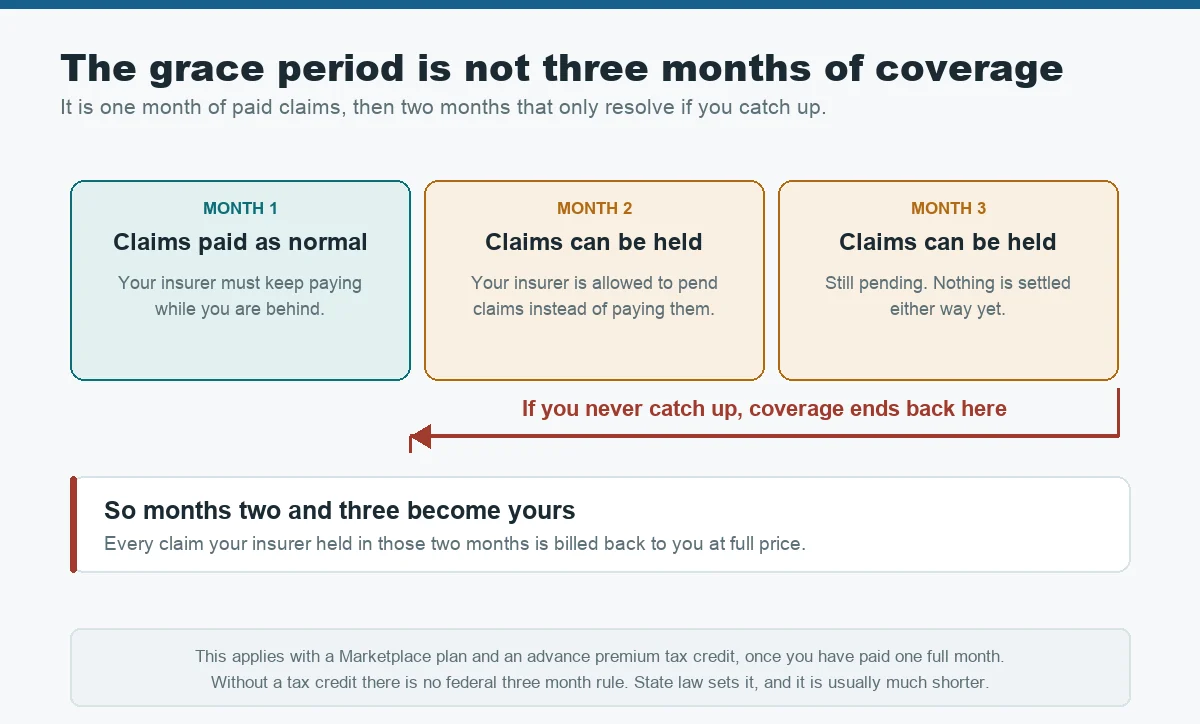
- Month one: your insurer must keep paying claims as normal.
- Months two and three: your insurer is allowed to pend your claims, which means holding them rather than paying them.
- If you never catch up: your coverage is terminated back to the end of month one, and every claim from months two and three becomes yours.
So the grace period is not three months of protection. It is one month of protection followed by two months of risk that only resolves if you pay in full.
If you do not receive a tax credit, there is no federal three month rule. The grace period is set by state law and by your policy, and it is usually far shorter, often around a month.
The practical takeaway is simple. Treat the premium like rent rather than a subscription, and set up automatic payment if your carrier offers it. KFF’s explanation of late premium payments goes through the mechanics if you want the detail.
Can Your Health Insurance Be Cancelled Without Notice?
No. Carriers have to tell you, and there are things they are not allowed to cancel you for at all.
Your plan cannot be cancelled because you got sick, because you made expensive claims, or because you reached some internal limit. Those protections are part of what makes a plan ACA compliant, and they are covered in our guide to what ACA coverage actually is.
What can end a plan is narrower than people fear, and it is mostly within your control:
- Non-payment, once the grace period has run out.
- The plan being discontinued for everyone, which comes with notice in the fall and an automatic mapping to a replacement.
- Losing eligibility, for example by moving out of the plan’s service area.
- A failed data check, where the Marketplace asked you to confirm income, citizenship or immigration status and never received it.
That last one surprises people. The Marketplace does not simply take your word for everything, and an unanswered request can end coverage even when the premium is being paid on time.
Can You Get Coverage Back After It Is Cancelled?
Usually not straight away, and this is the part worth understanding before it happens rather than after.
If your plan was terminated because you did not pay, you generally cannot simply pay the balance and switch it back on. Some carriers allow reinstatement within a short window, many do not, and you do not get to choose which kind you are dealing with.
Here is the detail that catches people hardest. Losing coverage because you did not pay for it is not a qualifying life event. Losing coverage counts when it happens to you, such as a job ending or ageing off a parent’s plan. It does not count when it happens because the premium went unpaid.
So a missed payment can put you outside the system until the next open enrollment, with no special window to rescue you.
If that is where you are, missed open enrollment in Texas covers what is genuinely still available, and short term health insurance is one of the options, with real trade offs rather than a simple fix.
The Deadline Nobody Mentions: Proving Your Life Event
If you enroll using a qualifying life event, you usually have to prove it happened, and you get about 30 days from picking a plan to send the documents, according to HealthCare.gov.
This is where special enrollment applications actually fail, and the pattern is always the same. People qualify, apply in time, select a plan, feel finished, and never see the document request sitting in their Marketplace account.
Your eligibility notice tells you whether documents are needed. If it does not ask, nothing is required.
| What happened | What usually proves it |
|---|---|
| Lost coverage from a job | Letter from the employer or insurer showing the end date |
| Moved | Lease, mortgage or utility bill showing both addresses |
| Married | Marriage certificate |
| New baby | Birth certificate or hospital record |
| Turned 26 | Proof of prior coverage and date of birth |
| Lost Medicaid | Termination notice from the state |
The honest part: this is administration, not expertise. Anyone who reads their Marketplace messages and keeps a folder of documents can do it. It goes wrong because people stop paying attention once the plan is selected, not because it is difficult.
Why Selecting a Plan Is Not the Same as Having One
A plan you have chosen but not paid for is not active. The first premium is what turns the coverage on.
Carriers set their own due date for it, usually before the coverage start date, and they are not obliged to chase you.
Two things make this go wrong more often than it should. People assume that finishing the application means finishing the job. And a card on file quietly fails, which nobody notices because nothing appears to happen.
If your coverage start date arrives and the first payment has not cleared, you may find out at a pharmacy counter. Pay the invoice as soon as it lands, then check the payment actually went through.
Do Employer Plans Work the Same Way?
No, and assuming they do is a common mistake.
Your employer sets its own enrollment window, usually a short one in the fall, and it has no relationship to the Marketplace dates. Miss it and you generally wait a year unless you have a qualifying life event.
Premiums work differently too. They normally come out of payroll, which removes the late payment risk almost entirely, and it is one of the genuine advantages of a job based plan.
If you are moving between jobs, the end date of your old coverage matters as much as any enrollment date, because losing it is what starts your 60 day clock. Health insurance between jobs in Texas covers that handover.
How Do You Stop a Deadline From Being the Problem?
Build a small amount of structure once, and none of this needs remembering.
- Put the two enrollment dates in your calendar with a reminder a week ahead, not on the day.
- Turn on automatic premium payment if your carrier offers it, and check the card on file has not expired.
- Open the mail from your carrier, particularly in the fall. Your renewal notice is the one that tells you whether anything changed.
- Check your Marketplace account after any special enrollment, because that is where document requests appear rather than in your inbox.
- Report income changes when they happen instead of at tax time, so your subsidy stays accurate and nothing gets flagged.
The honest limitation: every deadline on this page is public, and anyone who writes them down can track them. A broker keeping an eye on your renewal and your paperwork is a convenience, not a secret. It is worth having when life is busy and worth nothing when it is not.
Why This Matters More in Texas
Texas has the highest uninsured rate in the country and has not expanded Medicaid, which means more people here are relying on exactly these windows and fewer have a second route if something goes wrong.
In a state with expanded Medicaid, a missed payment or a closed window often has a fallback. In Texas, for a lot of working households, there is not one.
That is the real reason to care about the obligations rather than only the dates. The cost of a mistake here is higher, and the way back in is narrower.
For a wider view of how the whole window fits together, our complete guide to health insurance open enrollment and the Texas individual health insurance page both go broader than this one.
Conclusion
The health insurance deadline worth worrying about is rarely the one in the headlines.
- Doors decide whether you can buy. Miss one and you wait, which is frustrating but survivable.
- Switches decide when coverage starts. Miss one and you carry a month yourself.
- Obligations decide whether your plan stays alive. Miss one of those and you can lose coverage you already paid for.
- The grace period is shorter than it sounds. One month of paid claims, then two months of held ones.
- Non-payment does not open a special window. It is the one loss of coverage that does not count as a qualifying event.
If you would like someone to keep an eye on your renewal, your paperwork and your options in your county, Custom Health Plans is a Texas brokerage and the conversation costs nothing. Call (469) 361-4032 or request a quote.