
When does open enrollment end? For a plan you buy yourself in Texas, it ends January 15, 2027, and December 15 is the day that gets your coverage started on January 1. Employer plans close on a date your company picks, usually in the fall. The date matters less than what you do before it passes, and what happens if you do nothing.
Most pages that answer when does open enrollment end give a date and stop. You can find the date in ten seconds. What decides how your year goes is what you check before the window closes, and what really happens if it closes on you.
So this page keeps the dates to one table. The rest covers the checklist, the cost of doing nothing, and the routes that stay open afterward.
In a rush? Do these four things:
- Work out which window applies to you: a plan you buy, an employer plan, or Medicare.
- Check that your doctors and drugs are still covered.
- Open your renewal letter and read the new price.
- Pick a plan on purpose, even if it is the one you already have.
When Does Open Enrollment End in Texas?
It depends on who sells your plan. There is no single end date, because each type of coverage runs its own window.
| Type of coverage | When the window ends | If you do nothing |
| Plan you buy yourself in Texas | January 15, 2027 (December 15 for a January 1 start) | A marketplace plan usually renews at the new price |
| Employer plan | A date your employer sets, usually in the fall | Depends on your employer, so read the notice |
| Medicare | December 7 (the window opens October 15) | Your plan renews on its own |
| Medicaid and CHIP | It never ends, you can apply any month | Nothing to miss |
For a plan you buy yourself, Texas uses the federal marketplace at HealthCare.gov, so one set of dates covers the whole state. Enroll by December 15 and coverage starts January 1. Enroll from December 16 to January 15 and it starts February 1, according to healthinsurance.org.
The rest of this page is about the first row. That is where Texans make the most expensive mistakes.
If you want the dates in more depth, see our guides to when open enrollment starts and ends, ACA open enrollment in Texas and open enrollment for 2027.
Has Open Enrollment Been Extended?
Not in Texas, and it was nearly shortened instead. HealthCare.gov open enrollment still runs from November 1, 2026 to January 15, 2027.
A 2025 federal rule would have ended the federal window on December 15, starting with plan year 2027, as the American Hospital Association reported. A federal court blocked that change. CMS has said it has not changed the January 15 date.
The government has appealed the ruling, so future years could change. When does open enrollment end in practice? Treat December 15 as your real target either way.
Some states run their own exchange and set later dates. Texas does not, so those dates do not apply to you. Our guide to Open Enrollment 2026 vs 2027 explains which year your window belongs to.
What Should You Do Before Open Enrollment Ends?
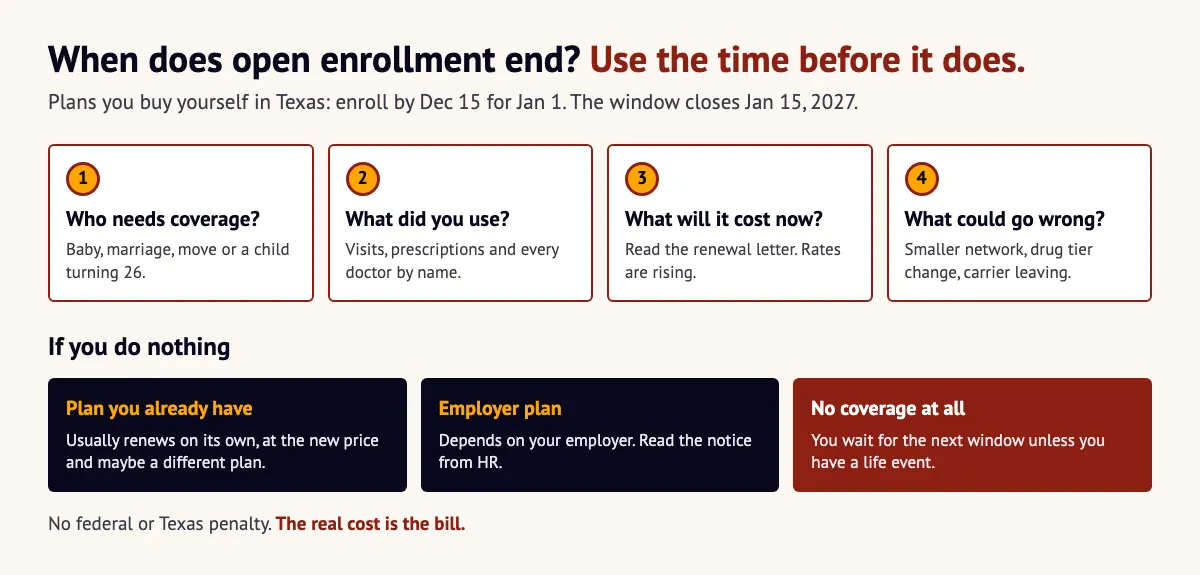
Ask four questions, in this order. Each one catches a different kind of surprise.
1. Who needs coverage this year? A new baby, a marriage, a move or a child turning 26 changes who belongs on the plan. Some of those also open a special window, so read our list of qualifying life events if one applies to you.
2. What did you really use? Look back at last year. Count the visits, the prescriptions and the bills. Write down every doctor by name.
3. What will it cost now? Read the renewal letter. Insurers proposed a median rate increase of 15 percent for 2027, and 63 percent of the proposed increases fell between 10 and 25 percent.
4. What could go wrong? Look for a smaller network, a drug moved to a higher tier, or a carrier leaving your area. Each one is easy to spot now and expensive to find in March.
A good habit is to finish this review at least two weeks before the date you care about. Whenever you ask when does open enrollment end, count back from that date, not forward from today. That leaves room to fix a mistake.
Why Check Your Doctors and Drugs Before It Ends?
Because a plan can keep its name and change its doctors. Networks and drug lists reset every year, and nobody calls to tell you.
Search each doctor by name. Then call the office and ask if they take that exact plan. The carrier’s name is not enough, because one carrier sells several networks.
Do the same for each prescription. Check which tier it sits in, because the tier sets what you pay at the pharmacy.
Plan type matters here. A PPO lets you see doctors outside the network at a higher cost. An HMO usually does not cover them outside of emergencies. If your doctor is out of network, that difference can decide your year.
If you are unsure how to weigh them, our guide on how to choose a health insurance plan in Texas walks through it step by step.
What Happens If You Do Nothing During Open Enrollment?

You now have the answer to when does open enrollment end for your plan. The next question is what happens if you let it pass. With a marketplace plan, you usually keep coverage and lose control. HealthCare.gov re-enrolls you automatically if you have marketplace coverage in December and do not choose a plan or stop coverage by December 15.
Renewal is not the same as staying put. HealthCare.gov may move you to a different plan from the same insurer. If your insurer leaves, it can move you to a plan from another insurer. It also warns that plan costs can change even when you are re-enrolled.
KFF strongly advises renewing actively, even if you like your plan. That is when you update your income and household details and recheck your costs.
Doing nothing can quietly cost you in four ways:
- A higher premium than you expected
- A different plan than the one you chose
- Old income or household details on file
- A doctor who is no longer in network
For employer plans, your employer sets the rule. Some roll your choices forward and some do not, so read the notice from HR. Medicare renews on its own, according to UnitedHealthcare.
Already renewed and want a different plan? You can still switch until January 15. We explain how in Can You Change Your Health Insurance Plan After Enrolling?
How Do You Compare Plans Before the Window Closes?
Compare the whole year’s cost, not just the monthly premium. A low premium often comes with a high deductible.
| What to compare | What it means | Why it matters |
| Premium | What you pay each month | The cost you feel first |
| Deductible | What you pay before the plan starts sharing costs | Sets your cost in a bad year |
| Coinsurance | Your share of a bill after the deductible, such as 20 percent | Adds up fast after a hospital stay |
| Out-of-pocket maximum | The most you pay in a year for covered care | Your real worst case |
| Network | Which doctors and hospitals the plan covers | Decides whether you keep your doctor |
| Drug list | Which prescriptions are covered, and at what tier | Decides your monthly pharmacy cost |
The plans you see first are not the only ones. A private PPO or an association plan can sit next to them, and both are worth pricing before you decide.
Our guides to individual health insurance in Texas, association health plans and health insurance alternatives explain how each one works.
Association plans and other private options are not tied to the same calendar. That is useful to know even if you never buy one. They work differently from marketplace plans, so compare what each one covers, not only what it costs.
When Does Open Enrollment End for Employer Plans and COBRA?
When does open enrollment end at work? Your employer sets the date, and it is usually in the fall, as UnitedHealthcare notes. It is also often only a few weeks long, so check your benefits portal or ask HR early.
Before it closes, confirm who is on the plan and check each family member’s doctors. Then decide on any HSA or FSA choices. If you pair an HSA with a high deductible plan, our guide to HSA insurance plans in Texas explains how the two fit together.
On COBRA? Your former employer runs its own window, and it is separate from the individual one. Read COBRA Open Enrollment: Stay, Switch or Save before you decide. Then compare it with COBRA alternatives in Texas.
Between jobs and not sure which route fits? Start with health insurance between jobs in Texas.
What Happens If You Do Not Enroll at All?
When does open enrollment end for someone with no coverage? On the same date as everyone else, and then the door shuts. You generally cannot buy a marketplace plan until the next one, unless something changes in your life. UnitedHealthcare says you may have to wait until the next period.
That is the real cost. You are not fined. You are exposed. Any bill in the months between is yours to pay in full.
Texas has the highest uninsured rate in the country: 16.7 percent in 2024, against 8.0 percent nationally. Missing the window is an easy way to join them.
If your coverage just ended, do not wait. Losing a job plan can open a 60 day window. Our guide to what happens after you miss open enrollment covers what to do first.
Is There a Penalty for Not Having Health Insurance in Texas?
No. There is no federal penalty and no Texas penalty. The IRS reduced the shared responsibility payment to zero for tax year 2019 and every year after.
Only a few places still charge their own penalty: California, the District of Columbia, Massachusetts, New Jersey and Rhode Island. Texas is not one of them.
No penalty does not mean no cost. The cost shows up as a bill. A gap can also affect what you can buy later, as we explain in Health Insurance Lapse Penalty Between Jobs in Texas.
Can You Get Health Insurance at Any Time of Year?
Yes, but not every kind. A marketplace plan needs open enrollment or a life event. Some other coverage does not.
| Route | When it works | The catch |
| Special enrollment period | Within 60 days of a life event such as losing coverage, moving, marriage or a baby | You usually send proof within 30 days |
| Medicaid and CHIP | Any month, if your household qualifies | Income limits apply |
| Private PPO or association plan | Any time of year | Works differently from marketplace plans |
| Short-term or fixed indemnity | Any time of year | Usually excludes conditions you already have |
The 60 day window comes from HealthCare.gov, and you then have about 30 days to confirm the event. Our guide to the special enrollment period shows who qualifies.
For the full set of options, read how to get health insurance outside of open enrollment.
Short-term plans can now last up to 3 years in most states. They are not major medical, though, so read short-term health insurance in Texas before you rely on one. Fixed indemnity plans pay a set amount for covered events and are not a replacement for major medical.
Which Mistakes Cost People the Most Before It Ends?
Most of them come from treating the answer to when does open enrollment end as a deadline instead of a decision.
- Mixing up December 15 and January 15. One decides when coverage starts, the other decides whether you can enroll. Our guide to the Texas health insurance deadline you cannot miss explains the difference.
- Treating a renewal as the same plan at the same price. Read the letter every year.
- Skipping the income and household update. Old details on file mean old numbers on your bill.
- Picking a plan without checking the doctor by name. The carrier’s name does not tell you the network.
- Choosing a plan and never paying the first bill. Selecting a plan is not the same as having one.
- Waiting for the last week. Problems found then leave no time to fix them.
Turning 26 this year? Your window may open early, so see turning 26 and health insurance in Texas.
Does a Broker Change Anything Before Open Enrollment Ends?
Not the date. Nobody can move a federal deadline, and you can run every step on this page yourself for free.
What a broker adds is comparison. A licensed Texas broker can put PPO, private and association options next to the plans you already see, in one conversation. Our guide on how to find a health insurance broker explains what to ask.
If you would rather compare with someone, a short call to (469) 361-4032 is enough. You can also ask for a free quote. There is no fee and no obligation.
Closing thoughts
When does open enrollment end is the easy question. What you do before it is what counts.
- Start with the right window. Your own plan, an employer plan and Medicare all close on different dates.
- Run the four questions. Who needs coverage, what you used, what it costs now, and what could go wrong.
- Never let a plan renew unread. The price, the plan and the network can all change.
- Missing it is not a fine. It is an open exposure to the whole bill.
- A missed date is not the end. A life event, Medicaid and private options can still be open.
So, when does open enrollment end? For most Texans buying their own plan, it ends January 15, 2027. The better question is what you do before it does. Start with our complete Texas open enrollment guide, and call (469) 361-4032 if you want a second set of eyes.